I have noticed the occasional remark in the past few days disparaging the Japanese trendy lemony-hop, Sorachi Ace.
‘Too much Sorachi Ace…’
‘Ugh, Sorachi Ace in it? No thanks…’
‘Considering it uses Sorachi, I quite liked it…’
It seems it really rubs some people up the wrong way. This is odd to me because, until recently, I had thought it was almost universally loved; a sort of subtle foil to the lupulin fireworks of American hops.
Sorachi Ace was born in 1988, from a pairing of Brewer’s Gold and Saaz, but has only in the past few years found popularity in the UK, presumably in line with the growth in experimental brewing. I’ve noted some people taste Sorachi Ace as an oily, bubblegum-like note, while others drinking the same beer will croon about the similarly subtle, fragrant, citrus and floral notes found in Thai cuisine.
Bristol Beer Factory’s Acer, Toccalmatto Zona Cesarini, Brooklyn Sorachi Ace (a saison) and Duvel Tripel Hop 2013 are all beers that I’ve had recently that use the hop, and I enjoyed them all. A lot. I generally quite like the lemon character that Sorachi Ace imparts to lighter-coloured beers of any strength. Sometimes it’s lemongrass, sometimes it’s lemon zest, or even dill. All shades of lemon, but still very welcome in the beers I’ve tasted it in, either on its own or in balance with other hops.
So why the schism? Is it a hop that can be used particularly unskilfully by brewers trying to ride the trend? Or are some people especially sensitive to Sorachi’s Aceness? I’d like to get a consensus here. Are you a friend or foe of Sorachi Ace?
After a period of intense, blog-abandoningly-busy writing, I am back in the saddle.
On Saturday, I attended the Hells Can Party at Camden Town Brewery, where their Hells Lager was launched in cans, at last. I say ‘at last’ because it feels like a long time since I first spied Camden’s small canning plant, and I had hoped to spend the summer with a few crates of Hells, or even USA Hells, in cans. Unfortunately, it took a lot of time (and as I am led to believe, extremely hard work) to get the Hells cans launched. Some noted the oddness of launching a canned lager this close to winter, but when it’s this good, I say why the Hells not?
Camden Town’s bold, sharp branding is perfectly suited for cans, and their artist Mr Bingo has really outdone himself on the Hells can design. A straight adaptation of the Hells Lager bottle label would have been more than enough to impress anyone, but the intensely and eccentrically detailed madness oozing from the Hells can label is something glorious to behold. Packaging aside, the beer inside is the same world-beating, ever-refreshing and fantastic-tasting lager. Once I’d poured it into a half pint mug, I must have finished it in about four or five incredible gulps, a few of which washed down a wonderful pulled pork bun from the lovely man at Prairie Fire BBQ. By eck, even the flipping Mayor (of Camden, sorry Boris fans) showed up.
Anyway, I’ve written about my feelings on cans before, but in a nutshell (for those of you who don’t like being told to click on links when you’re right in the bloody middle of reading something), I think they are the future for packaged Good Beer. Bottles will be seen as premium and special; and bottle-conditioned beers will be treated with even more reverence as a result. Fresh, hoppy beers, however, especially those that have travelled some distance, almost always benefit from the total protection that a can provides.
What’s needed is a few other small UK breweries to take the plunge and get canning. It really needs to suit their image and branding, too. The Kernel, for example, would never can their beer and I wouldn’t want them to. There are some brewers however, whose branding and beers would be fantastic in canned form. Here’s my wishlist:
1. Magic Rock Brewing – Tell me – go on, just try – that Magic Rock’s madcap labels wouldn’t look sensational on a shiny can, especially the metallic ‘shiny football sticker’ labels given to their more limited beers. As for the freshness of those hoppy monsters, well, just imagine cracking open a can of Human Cannonball or Magic 8 Ball and let me know when you’ve finished drooling.
2. Tiny Rebel Brewing Co – A brewery that’s going from strength to strength, Tiny Rebel are just the kind of brewer to embrace canned craft beer. Their labels could even make the cans look like the spray paint used by their hoodlum teddy bear mascot. Just the thought of beers like Hadouken and Full Nelson tasting brewery-fresh already has me all excited.
3. Oakham Ales – There’s something about Oakham’s beer labels that already reminds me of cans, as they often use a bright, rectangular image that could fit onto one just so. I’d love to be able to come home to a fridge full of cheeky, hop-faced cans of Citra, or, be still my beating heart, Green Devil IPA.
4. Beavertown Brewery – Beavertown’s bottled beers are almost always bottle-conditioned as far as I can tell, but if they could pull off can-friendly versions of Black Betty, Gamma Ray and 8 Ball, I think their branding would look even cooler than it already does on their bottles. Imagine cans of Beavertown at your next barbecue – surely a dream come true.
5. Meantime Brewing Co – It’s surprising in many ways that this old stalwart (over ten years old, people, that’s ancient) of the London brewing scene hasn’t dabbled in cans. They have the quality, consistency and capacity. Cans might not somehow suit the brewery’s schizophrenic mix of innovation and tradition, but really, they should.
I think the main issues, as is always the case with canning, is whether the brewers have the capacity and demand. BrewDog famously outsourced the brewing and canning of Punk IPA cans to Thwaites, but following the building of their new brewery, have taken canning of their beers back home.
Given that a brewer based under a railway arch (admittedly that goes for a lot of London brewers) can pull this off, surely plenty more can, too. What do you think? Is there a brewer in the UK who should be canning their beer and they aren’t? Or is it all a Craft Wanker fly-by-night flight of fancy, best left to them bloody Americans and that? Perhaps, but as Craig Heap notes, the UK has a tradition of canned beer innovation. Let me know what you think in the comments.
The Complete Homebrew Handbook. Available from WHSmiths, a big Sainsbury’s, places with lots of magazines…
So there hasn’t been much going on the blog lately, and here’s why…
That notorious Cwrwaft Wanker Craig Heap and I have written some features that have gone into this new one-shot magazine about homebrewing: The Complete Homebrew Handbook.
It costs £9.99, and for that you get a guide to starting homebrewing using kits, malt extract or full-mash, as well as information for intermediate and seasoned homebrewers. For example, there’s a piece about finding the right branding, and advice on how to go commercial.
The main reason it’s worth that price is the fantastic list of official recipes inside, for ace beers like Magic Rock Clown Juice, Odell Cutthroat Porter, Rooster Fort Smith, BBF Southville Hop, Tiny Rebel Hot Box and Moor Illusion. Seriously, there are some amazing recipes in there.
I didn’t write any of that really interesting stuff, though. I just wrote some features near the front about ingredients and what they determine in the finished beer. My bits are about malt and yeast, and also I did an interview with Chris at Warminster Maltings. Any unseen typos notwithstanding, I’m pretty chuffed.
The finished magazine is a very nice thing. More like a book really. The publisher insists on calling it a ‘bookazine’, but for those averse to newspeak, Big Magazine will do. You can buy it in WHSmiths, large supermarkets (Sainsbury’s definitely have it) and places that have lots of magazines. You can also order it online (and preview the contents) here.
Anyway, that’s one reason I haven’t blogged in a while. The other reason is this New Thing, which I will be promoting the absolute blummin’ heck out of in a few weeks time.
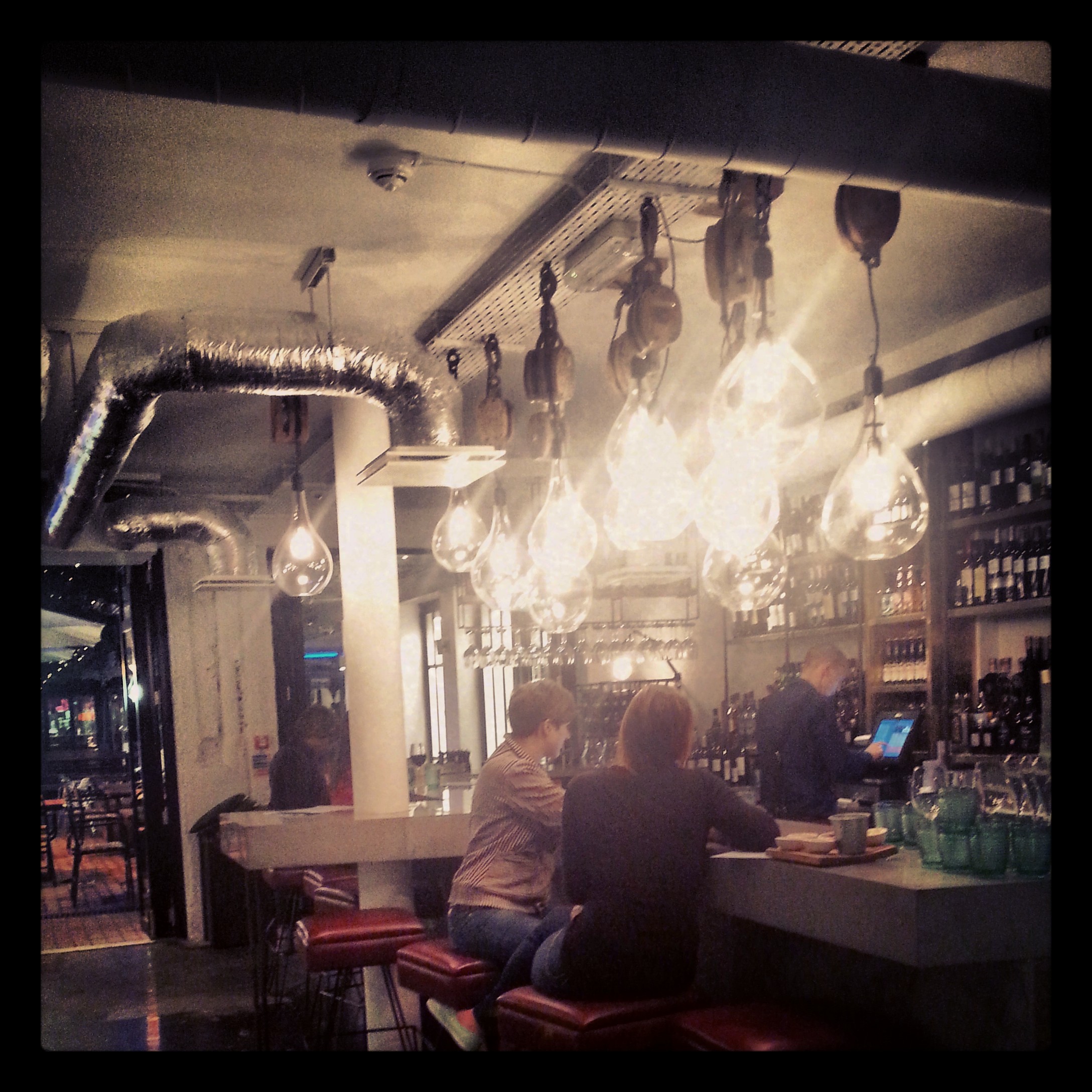
Whyte & Brown, Kingly Court, Carnaby St, London W1B 5PW
For a restaurant, finding a niche is a dangerous business. Too obscure, and you become something that people only visit once, at best. Too mainstream, and you suffer the same fate. Why bother going back to something you know is nothing special?
Free range chicken and eggs, in that case, may sound like the worst of both worlds – weird yet mundane – but Whyte & Brown is a genuinely different and interesting restaurant that is even more valuable to seekers of good beer.
This is the chintzy, brand-splattered cobbles of Carnaby Street and Kingly Street, where truly good beer is restricted to the occasional handpulled gem or bottle of Punk IPA at nearby Nicholson or Taylor Walker pubs. This whole area of London is a gamble for beer geeks. The few bright lights therefore shine ever the brighter, and W&B, nestled in Kingly Court, deserves recognition for this alone.
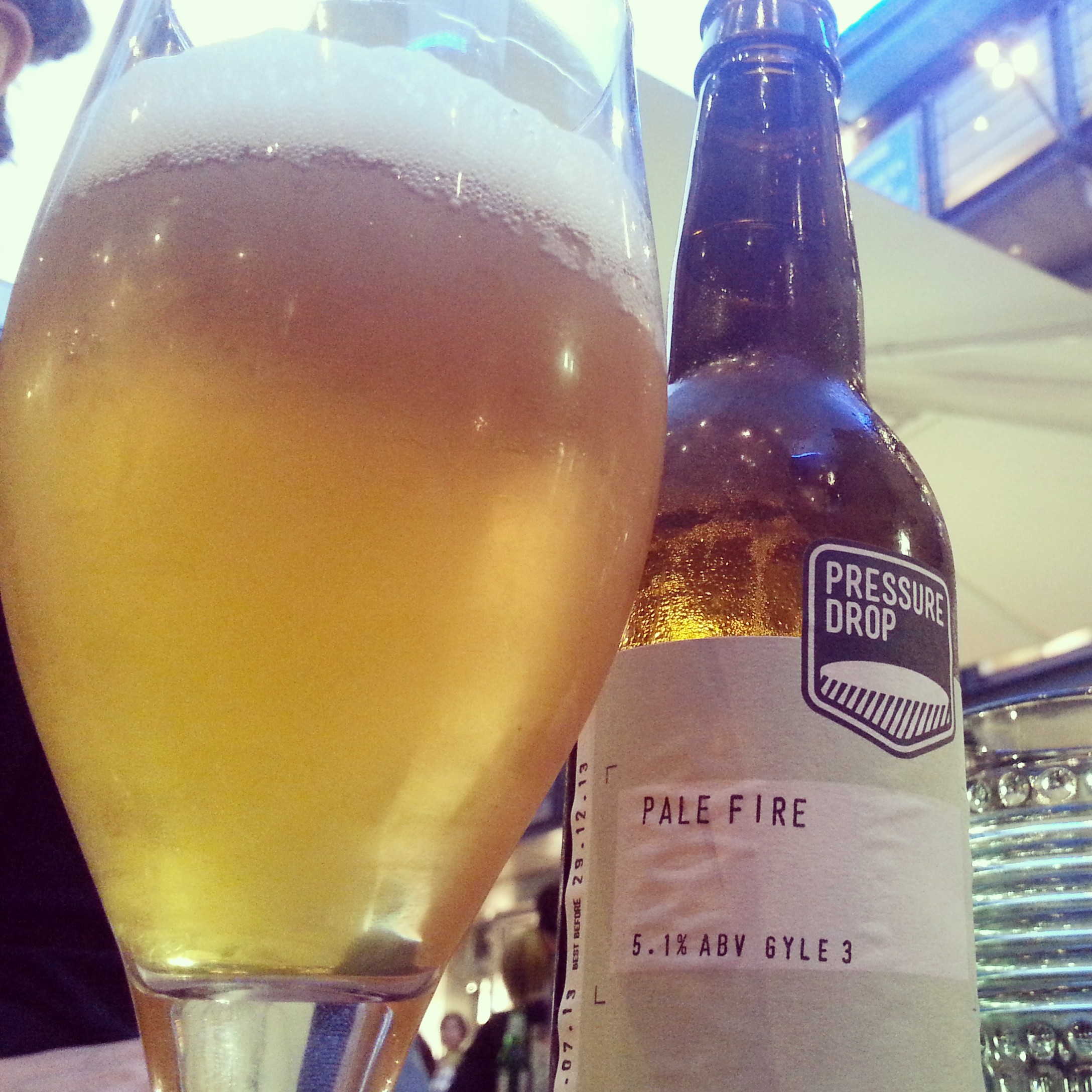
If a pub or bar, and a really good one at that, had the likes of Beavertown Gamma Ray, Redwillow Wreckless, Hardknott Cool Fusion and Pressure Drop Pale Fire on the menu, you’s sit up and take notice. Now imagine a restaurant that has that kind of beer range. A restaurant that sells things like shards of crispy chicken skin as a snack. Now I have your attention.
Chicken skin and pate-gasm.
It doesn’t stop there. W&B even got Redwillow to brew their house ale: Whyte Draught, a clean and floral pale ale that has those Redwillow hallmarks of balance and clarity. I was invited to a evening of food and beer at the restaurant last month, and had a fantastic time. Toby McKenzie of Redwillow was there, along with Justin from Moor Beer, and a few friendly faces from the Twittersphere. We were treated to a seemingly endless feast of chicken. Chicken thigh-meat coated, Thai-spiced Scotch egg, Harissa chicken hot hot hot chicken wings, the restaurant’s signature Brick Chicken (more on that later), and pulled chicken thigh meat in a delicious BBQ slider. All the beers were there, and we were encouraged to find our own matches, and share our findings. This, as a side note, was a really pleasant and social way of doing that kind of event. No script, directions or explanations; just food, beer and chatter. Lovely.
Harissa hot wings with, ingeniously, caramelised orange wedges.
I had a wonderful evening at W&B, and raved about it to everyone I talked to afterwards. Then I came across a couple of very shirty, sniffy reviews of the place online, by actual food critics. Both questioned the place’s reason for being. Being just about high-quality chicken and eggs was not, in their eyes, enough to validate the restaurant’s existence in London. I truly hope that I never grow into the kind of joyless, whining, misery-balloon that cannot tolerate a restaurant’s existence purely because it doesn’t meet their idea of what’s supposed to be in London. Both of these reviews missed a very key point that I think is of the utmost importance: WHAT ABOUT THAT BEER, HUH?
Bombay Scotch Egg
Seriously, though: W&B’s beer menu is a small and perfectly-formed marvel that gives me hope, real hope, that there might be more restaurants like this one day. So many existing excellent beer and food places are beer places first, or are owned by breweries. It was so refreshing and heartening to come across somewhere that had a very specific food vision, and also just happened to absolutely get good beer being a part of that.
Brick Chicken
Anyway, I resolved to return to W&B. I thought that maybe all the beer and fun had clouded my perception. Was the chicken really that good? So I sat outside – the place has a lovely chunk of Kingly Court to enjoy the last crumbs of summer and autumn in – and ordered a bottle of Pressure Drop Pale Fire with another plate of the magnificent Brick Chicken. Because that’s what it is: magnificent. Marinated chicken breast cooked under a brick to moist, juicy perfection; 24-hour slow-cooked chicken thigh and a slow-cooked wing. It comes with a jug of gravy so good that you should be able to order it as a beverage. Sharp, juicy, citrusy pale ale and crisp-skinned, moist-meated chicken. If that’s not a reason for a place to exist, then I don’t know what is.
Left: Lavender Hill honey beer, Right: Battersea Rye.
It’s funny to think of Sambrook’s as an old timer in the ‘new’ London brewing scene, but that’s pretty much what it’s become. Now at the ripe old age of five, it’s spent most of that time quietly claiming the handpulls and hearts of south London, with beers like Wandle and Junction. These stalwart beers (not unlikeable, but perhaps hard to think of as special) have been joined by the likes of Pumphouse Pale Ale and Powerhouse Porter, both acclaimed examples of their respective styles.
On Saturday I was kindly invited by Jo at Sambrook’s to their fifth birthday celebration. ‘Beer By The River’ was a joint venture with the National Trust, held at Morden Hall Park by the river Wandle. A fitting location, yet sadly hampered by damp and drizzly weather that had people hiding in the beer tents for most of the afternoon. The setting was a walled-off part of the park, with a stage provided by the Artful Badger, showing excellently named folk and indie acts such as Toyface and The Hallouminati. Two beer tents were separated by a line of food vendors: Ginger Pig, Dessert Deli and Fish Club. There was also face painting and a few ducks, chicks, rabbits from Deen City Farm (for the benefit of families attending the afternoon session – no adults were quaffing ale with their face painted like a tiger, sadly). The only thing missing was a view of the Wandle itself, which was disappointingly obscured by a brick wall.
Folie Ordinaire performing on the Artful Badger stage.
Naturally, my main focus was the beer on offer, which you got two 1/2 pint tokens for on arrival. I was pleased to see a couple of Sambrook’s beers I hadn’t tried before: Lavender Hill braggart (honey beer) and Battersea Rye, a seasonal special for autumn. The Rye in particular was lovely: the pepperiness balanced with earthy British hop bitterness and a very indulgent palate of crystal and chocolate malt. It was by no means a Sambrook’s-only festival though. Gadd’s, Five Points, London Brewing Co and Tap East all had cask beers served on gravity behind the bar. My favourites of the day were the three beers from Tap East: Niwot India Red Ale, Smokestack Porter and their outstanding American Pale Ale. Their beers absolutely shone all day long, unlike that pesky sun slacking off behind the clouds. For a ‘small’ range of beers, it was incredibly varied in terms of styles, strengths and flavours.
The food selection was quite varied too, with plenty on offer for meat eaters, but perhaps a bit limited for vegetarians. Having said that, the beer battered halloumi from Fishclub was apparently very good indeed. I plumped for a very enjoyable box of fish and chips (line caught haddock and twice cooked chips, dontcha know, though one nearby Chip Wanker remarked he could taste that they had ‘only been cooked once’). That cost £9.50, though in real terms it was only £4.50 since the entry ticket also gets you a £5 food voucher. The fish and chips went down very nicely with a glass of Five Points Pale Ale, which, whilst seeming a little flat served by gravity, still had an incredible tropical fruit aroma.
For most of the afternoon, the event was quiet, with sixty or so people plodding about the muddy field. It was a shame, because if the weather had been as willing as the Northern Line (spectacularly free of engineering works for once) it could have had a great atmosphere all day. Originally, the event was set to run as two sessions – 12pm-5pm and 6pm-11pm – but due to the decreased turnout, they instead ran them together. It was a shrewd decision, and the place really came alive just after 6, when the long-haulers decided to stay for ‘just one more’ as a fresh crowd arrived. It was around this time that I decided to cash in my voucher for a 1/3 pint of Sambrook’s 5th birthday celebration beer: their new No 5 Barley Wine. This 8.2% warmer was an impressively (and dangerously) drinkable beer, with banana, malt loaf and sherry notes ending in a curiously dry and moreish finish. Keep your eyes peeled for a bottled version.
I was glad that we stayed late, if only to see the event get the numbers it deserved. I think the ticket cost of 17 quid was a little over the odds for what was there on the day, but if it had been blessed with the glorious sunshine of a week or so earlier, I’m sure people would have paid hand over fist to sit there all afternoon with beer and music. As it was, having several excellent beers and some good food just about took the edge off spending the day in a damp field. I don’t wish to sound harsh though, because I had a lovely day, and look forward to more events like this in the future. Maybe a little bit closer to that lovely river next time…
Cantillon: please consider bringing back this incredibly cool dragon logo. Far better than that dodgy old fat bloke falling off his chair.
Another post that should have gone up weeks ago and, yet again, I’m in an awkward position.
You see, I’ve read plenty of blogs and articles about Cantillon, each of them gushing over the weirdness, the smell, the gaps in the roof, the barrels, the cobwebs – oh how they love the cobwebs – and all the rest of it. I’ve read them and thought: right, I get it. It’s a special place. Lambic and Gueuze are undoubtedly Very Important Things. The brewery is a lonely bastion of a dying art form, and we must all kneel down at its spontaneous altar and take wild-fermented sacrement. I understand, okay?
A notorious Craft Wanker wanders the cellars, sucking different ages of lambic from damp patches on barrels.
The awkward thing is, having read all of that, and having thought it was well-meaning but over-enthusiastic, I now find myself having been to Cantillon and agreeing with every single word of it. It actually is a genuinely magical place.
It’s likely you’ve read all of that stuff about Cantillon, too. It’s fairly likely you’ve been there yourself. It is, after all, one of the few places that beer geeks might consider a pilgrimage-worthy destination, and rightly so. So what’s the point of me adding to all that’s been written? I might not be able to offer up a different opinion, but I might be able to persuade those of you who haven’t been to Cantillon to seriously consider a visit.
Lens flare? Divine intervention? Hard to say once you’ve tasted the contents.
For one thing, during the summer, when the temperature is too high for them to brew, you are basically allowed to wander around the place unsupervised. Pay the nice people at the entrance the paltry sum of €6, and they’ll turn you loose inside after giving you a machine-gun-speed briefing on the brewery and a leaflet. We ended up wandering in on a bit of the guided tour, but my favourite memories are from the solitary exploration of the place. The deafening quiet enhanced every smell, sight and touch; made every surprised glance a discovery, every surprised intake of breath a gasp. I imagined coming across the brewery in some bleak, post-apocalyptic setting, overgrown with plants like in Logan’s Run, and the whole place being exactly the same.
I do love a good koelschip.
The whole place is a bit like the obligatory ‘museum’ bit of a larger brewery tour (like when I visited Brouwerij De Halve Maan), except it isn’t a museum, it is the brewery. Gauges and pipes are insulated with scrunched-up paper, vessels are laid open for you to poke your nerdy head into, and that smell pervades everything. It’s one thing being told that the atmosphere of the brewery does the brewing, but in Cantillon it’s a tangible force that you can detect everywhere.
Even the beer you’re given at the end is ridiculously good. Yeah, I admit, that first taste of dusty, sour, mystical, raw lambic required some serious thought. What is this? But as it sits there on your tongue, and tells you its story, you just have to keep tasting it. All those cobwebs and damp, sticky patches on the barrels, the dust, the air, the wood, it’s all in there. And as for the Rose de Gambrinous, well, it’s simply sensational. Once again, Belgium gave me a Beer Moment(tm). Lambic and Gueuze ARE magical and weird and wrong yet so, so right. It’s all about the context, and understanding. When I sat there, drinking those beers under the gaze of that dragon, I felt like I understood What It’s All About.
A glass of wonderment, calling itself Rose de Gambrinous.
You see? This blog has turned into just another fawning gushfest.
It’s taken me a while to write this post. It has a lot to do with a lack of spare time, but when I have had time, I’ve still struggled with it. I’ve rewritten this post several times over the past week or so, never happy with what I’ve said or the conclusions that I’ve reached. I think it’s actually the pursuit of a conclusion, the need to have something to say and not just report the things I saw/tasted, that has hampered me.
I wanted to directly compare the Great British Beer Festival and the London Craft Beer Festival. The scheduling overlap of putting LCBF right on the closing weekend of GBBF makes it clear: this was what the organisers of the LCBF wanted us all to do. Compare. Contrast. I even saw people on Twitter two weeks earlier asking whether people would pick one, or both. Whilst there was nothing as tangible as an actual competition or rivalry between GBBF and LCBF, there should definitely have been closer examination of what these two festivals represent in the modern beer landscape. At least, that’s what I thought at the time.
… and in the red corner: LCBF.
The truth is that they can’t be directly compared. With GBBF, we have a firmly established behemoth of the British beer scene, stocking over 800 beers in the enormous and beautifully lit surroundings of Olympia. LCBF is a far trendier, tight-jeaned urban animal, nestling in Hackney’s suntrap/gig venue that is Oval Space.
Comparing attendance figures would be like comparing those of Premier League and Conference football matches, and sheer size is not really the point of a beer festival. It’s the experience and the beer that we actually drink, not see, that we measure beer festivals by. My experiences and the beers I tasted were so vastly different that, again, they defy comparison.
Standard perspective shot of some pumps taken at a just-as-the-beer-takes-over angle.
At GBBF’s trade session on Tuesday, I bumped into CAMRGB’s Simon Williams. We were stood by the Bieres Sans Frontieres Bottle Bar (AKA The Globe), which I had sought out expecting to find people I knew there. But the USA cask bar, The Spirit of Enterprise, was on neither side of The Globe, as normal. “I’m looking for my friends, you know, all the Craft Wankers,” I explained to Simon, who pointed me to the other hall, where the USA cask bar was located. Off I went, and indeed I found a veritable Growler of high-quality Craft Wankers propping the place up. My girlfriend remarked “Oh my God, he was right!” There was even a chap with the names of four varieties of wild-fermenting bacteria on his t-shirt. Seriously.
I eventually met with several fine people, and drank a great deal of good beer. But given the hype, the excitement, the brewers and the beers themselves present, few were better than just ‘good’. It almost seemed a cruel joke in a way, that the hugely popular bar of American imported draught beers were a) on cask, and b) all right but rarely incredible. Many remarked that they needed to be served by keg or bottle to be at their best. Craft wankery? Perhaps. But it was hard to deny the truth in it. There was also the occasional bit of GBBF Weirdness (see below).
The juxtaposition of a Cornish wrestler dressed as Betty Stogs and a hot dog vendor’s sign saying ‘TRY MY TWENTY INCHER’ was almost too much for this correspondent.
On Saturday, the chaotic, barrel-scraping end to GBBF was in full swing by the time I got there. Maybe 60-70% of the beers on most bars had gone, so it was a case of plumping for whatever was selling and looking good. I had a couple of so-so golden ales, then came across a few delights. My focus on Saturday was on British beer. I’d stuck mainly to the USA cask, Belgian/Italian cask and BSF bottle bar on Tuesday, and felt that I ought to seek the very best British beer I could find. I was hoping to replicate my moment of elation at last year’s GBBF after trying Oakham Green Devil for the first time. I couldn’t find a beer to match it this year, but I came close a few times.
How many things can you hang above a terrace? Quite a blummin’ lot, mate.
At LCBF meanwhile, I expected a similar situation on a larger scale. Again, I went on a trade/press session, this time on Friday afternoon. Instead, I found that the crowd was more varied than I might expect. Sure, there were a lot of Hackney People, who work in Those Sorts Of Shops and have friends who laugh Very, Very Loudly, but for the most part it was a very relaxed, eclectic crowd. Trade sessions, however, are not always the true litmus test of these things I suppose. I spent most of my time up on the shady terrace, chatting with nice beer people, drinking increasingly excellent beer and feeling far more relaxed than at GBBF. The other outside area, a long sunny balcony, had a slightly too oppressive view for my mood.
Who controls the craft controls the universe.
LCBF’s large indoor space was covered on three sides with bars, with beers from Five Points, De Molen, Weird Beard, Beavertown, Magic Rock, Kernel, BrewDog, Alpha State, Partizan, Brodies, Siren, Redemption and more, all served from keg. The conditioning, temperature and quality of all the beers I tasted on Friday was impeccable. Easily the most consistently good quality dispense I’ve experienced at any beer festival in fact. I’ve been served cask beers in better nick on occasion, but far, far more rarely than I would like. Siren’s Limoncello IPA was on top form, as was Partizan’s Camomile Saison and Magic Rock’s Lime Salty Kiss. Each beer I had at LCBF was an absolute delight.
GBBF’s dispense quality varied from bar to bar, beer to beer, but overall was still very impressive. The occasional dud was normally offset by something quite sublime. It was great to taste the Malt Shovel Mild, brewed by Fernandes in Wakefield. Aside from it being a really great mild, I have fond memories of drinking in their brewery tap (the fittingly named Brewery Tap) back in my student days. There was some great weissbiers being served on the German and Czech draught bar, especially the Josef Greif (for which I was given grief for pronouncing it grief when it should be said grife). Though, if I had one regret from Saturday at GBBF, it would be not spending more time at the SIBA bar, where I had a magnificent specimen of Kirkstall Dissolution IPA.
So, if I can’t compare the two beer festivals directly, and I had a great time at both, what can I say that’s worth saying?
For starters, both festivals are a measure of the health of the beer scene. Whilst we are starting to hear of closures of newer breweries, indicating an imminent plateau, there is also a steady increase in the number of beer festivals that aren’t organised by CAMRA. These may be run by people who just want to make money, they may be run by people who simply want to be the best at it (Craft Beer Rising are probably leading that particular pack). The most important thing is not just that the current beer ‘scene’ in London, such as it is, can sustain two vastly different beer festivals, but that they can be happily attended by the same people.
It might not be an earth-shattering conclusion, but it’s the only one I can really get behind. We have a vibrant culture of beer that is creating excellent events and encouraging the brewing of even more excellent beer. So let’s all enjoy it while it’s here.
A notorious Craft Wanker loiters outside the brewery, begging for slops.
Walplein 26, 8000 Brugge
“They do a good tour, but be prepared to hear a load of bollocks.”
This was the glowing recommendation given to me by Melissa Cole. Broadly speaking, Melissa is right. On the tour of Brouwerij De Halve Maan, brewers of Bruges Zot and Straffe Hendrick, you will hear a few things that might get your Beer Geek hackles up. There’s also a lot of stuff about the magical medicinal properties of all of the ingredients, which is mostly fun if occasionally presented as fact. These minor quibbles aside, it really is a fantastic tour, and a lovely building to explore.
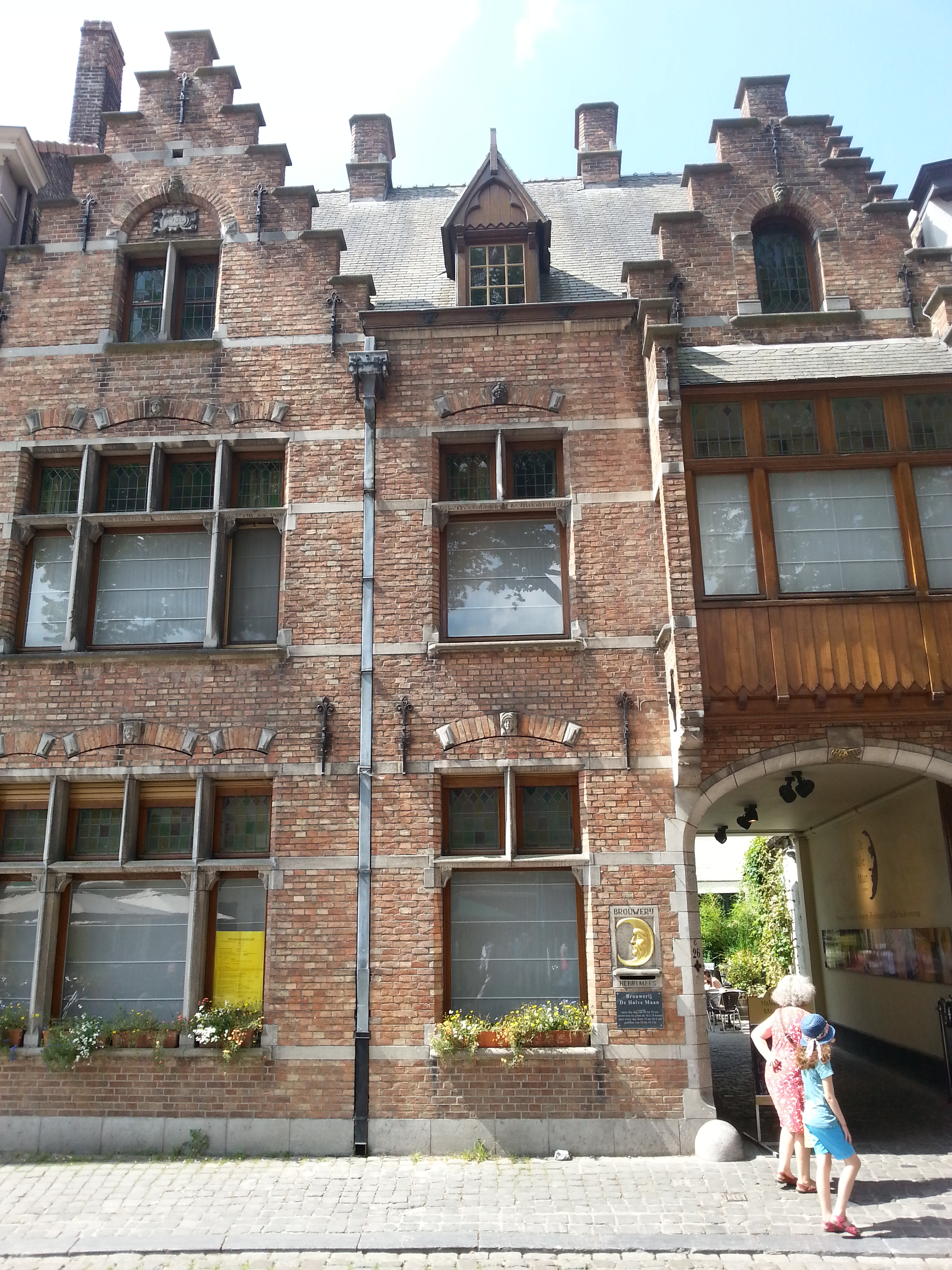
It isn’t immediately obvious from the exterior that De Halve Maan was an old-fashioned tower brewery. The building above, with its coaching inn-style tunnel, sits in front of a courtyard where a restaurant and gift shop is located. Once you’ve bought your ticket for a very reasonable €7 (including a beer at the end), you simply have to wait until the next tour starts, which is on the hour.
The tour starts in the shiny, modern brewhouse, where everything is situated on one floor. Everything is clearly labelled for visitors, and the brewing process is briefly explained. Whilst it looks as clean and new as, say, Camden Town Brewery, there is still a reassuring adherence to old-fashioned eccentricity. The control board below, for example, has a delightfully steampunk feel to it. Why have a touchscreen when big, pushable buttons and levers will do the trick? It reminded me a bit of Bertha, the magical factory machine from the kids’ TV show of the same name.
The real treats are upstairs. As mentioned above, originally De Halve Maan functioned a tower brewery, relying on gravity to propel the liquid through the brewing process. So up, up, up we go, ascending narrow steps and low ceilinged passages into the malting floor. Here there are all kinds of fine-looking brewing artefacts from the brewery’s 150 year history. It’s here on the malting floor you get a more in-depth talk about the value of each specific ingredient in the process.
The tour guide, whose name I can’t remember, won me over after sizing up a chap who had been asking a lot of questions about what was or wasn’t regulated in Belgian brewing: “You’re German, aren’t you?” Cue laughter from everyone. The talk was a fan and factoid-packed, but could be politely described as being ‘unburdened by the truth’. To some extent you could understand the German guy’s constant questions; he admitted he was a homebrewer. However, I could tell that he was asking questions he knew the answers to, and was really just testing the tour guide, which is far worse in my mind that coming up with a few half-baked facts about the medicinal benefits of beer.
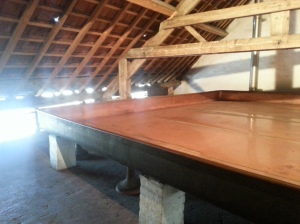
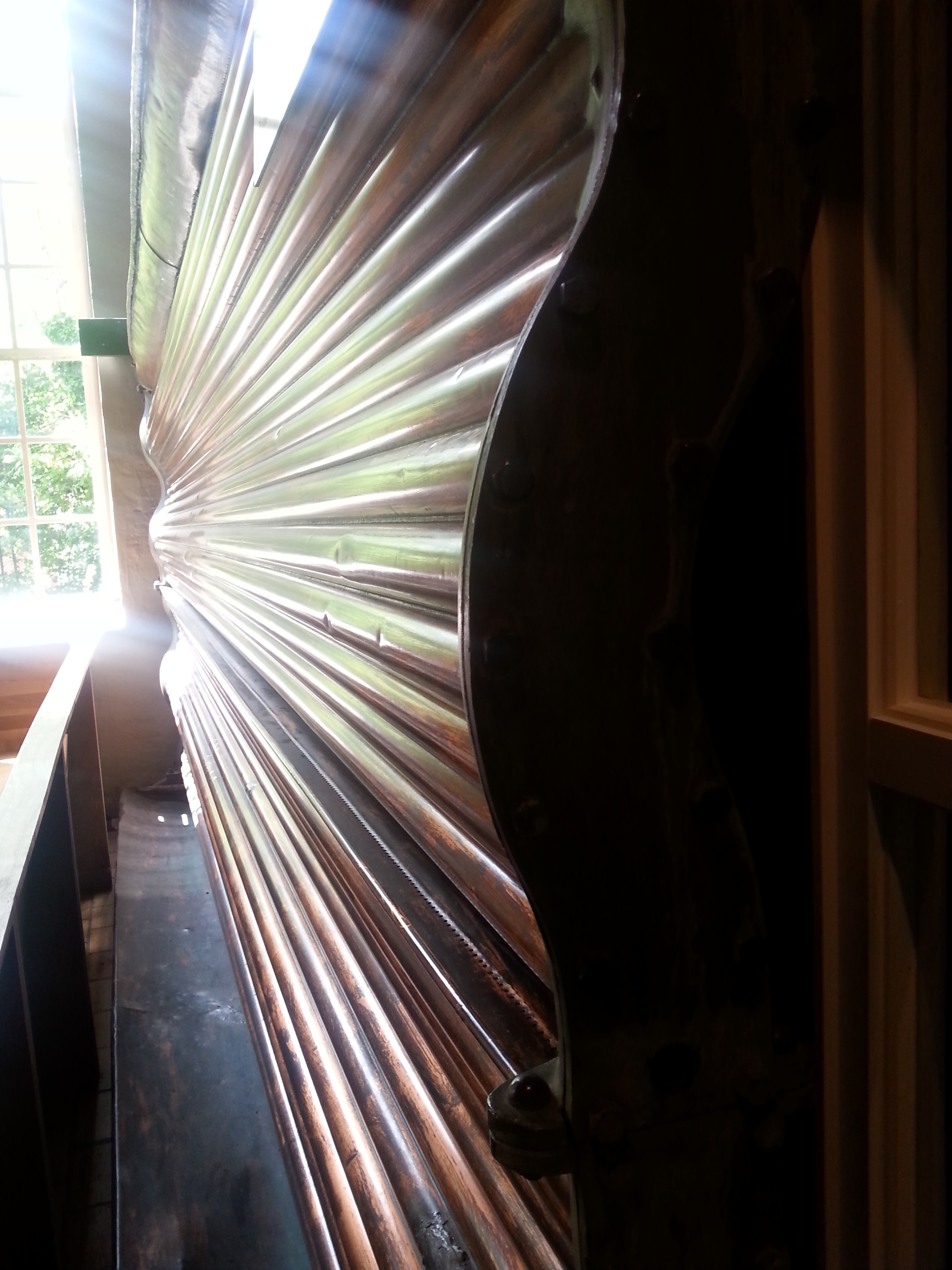
Anyway, as I said, its the building itself that really makes this tour special. You get to see, or rather walk across, the old koelschip (a broad, shallow, copper vessel where hopped wort would cool down while being exposed to wild yeast and bacteria) on the way to the roof, where you can enjoy a glorious panoramic view of Bruges. Then, climbing down even narrower stairs than before (backwards), you get to see the beautiful old heat exchangers, fermenting vessels and maturation tanks. Tall people beware, you may spend much of the tour in an Igor-like crouch. To the guide’s credit, you will learn a lot of history as well as Beer Facts ™, and there are plenty of stories in the old copper vessels.
1930’s heat exchangers are pretty.
When the tour is over, you’re guided to the lovely on-site bar, where you’re handed a cool glass of unfiltered Bruges Zot, the brewery’s flagship blonde ale. It’s a fairly common sight in bottles in the UK, and a decent Belgian blonde, but by no means exceptional. The unfiltered version (like most unfiltered versions of anything) is a superior product, with a more pronounced, zestier, citrus finish and a smoother, creamier mouthfeel. I can also recommend the Straffe Hendrik Quadrupel, which, whilst not the usual Trappist quad to find beer geeks fawning over, is a really decent drop – full and syrupy sweet, with a moreish balance of toffee, chocolate and coffee notes.
If you know a bit about beer and brewing, and have a few people with you who don’t know much at all, then De Halve Maan will give you a very accessible and fun brewery tour. Even if you know a lot, the tour itself is still fun, and any ropey information is completely outweighed by the friendliness of the guide, the beauty of the building, and the delicious beer at the end. €7 well spent.
Some informative reading in Cambrinous, featuring TV’s Alf, apparently.
In my last post, I covered two fantastic bars in Bruges: De Garre and la Trappiste. Below are two of my other favourite places I visited in Bruges: Cambrinous and ‘t Bruges Beertje.
Cambrinous, 19 Philipstockstraat
Cambrinous occupies one of those very ‘Bruges’ buildings: old red stone, zig-zagging to a tip like two sets of stairs at the top, oozing character and warmth. Some of the masonry on this particular building sets it apart. The King of Beer, Cambrinous himself, is depicted, straddling a massive barrel. Inside, a long bar overlooks a sunken seated area of booths and tables. We managed to get a window seat, where copper pipes and light fittings nestle in the corners.
The beer list here is extensive, 400+ at any one time, and my eye is drawn to a brewery recommended to me: Brasserie De La Senne. Taras Boulba is their ‘Extra Hoppy Ale’, and in the glass it shines like freshly squeezed fruit juice. From Saaz hops alone it manages to squeeze out lemon, grapefruit, mandarin, lime and orange, building to crisp, dry, peppery finish. It’s a stunning beer, destined for enjoyment in sunshine.
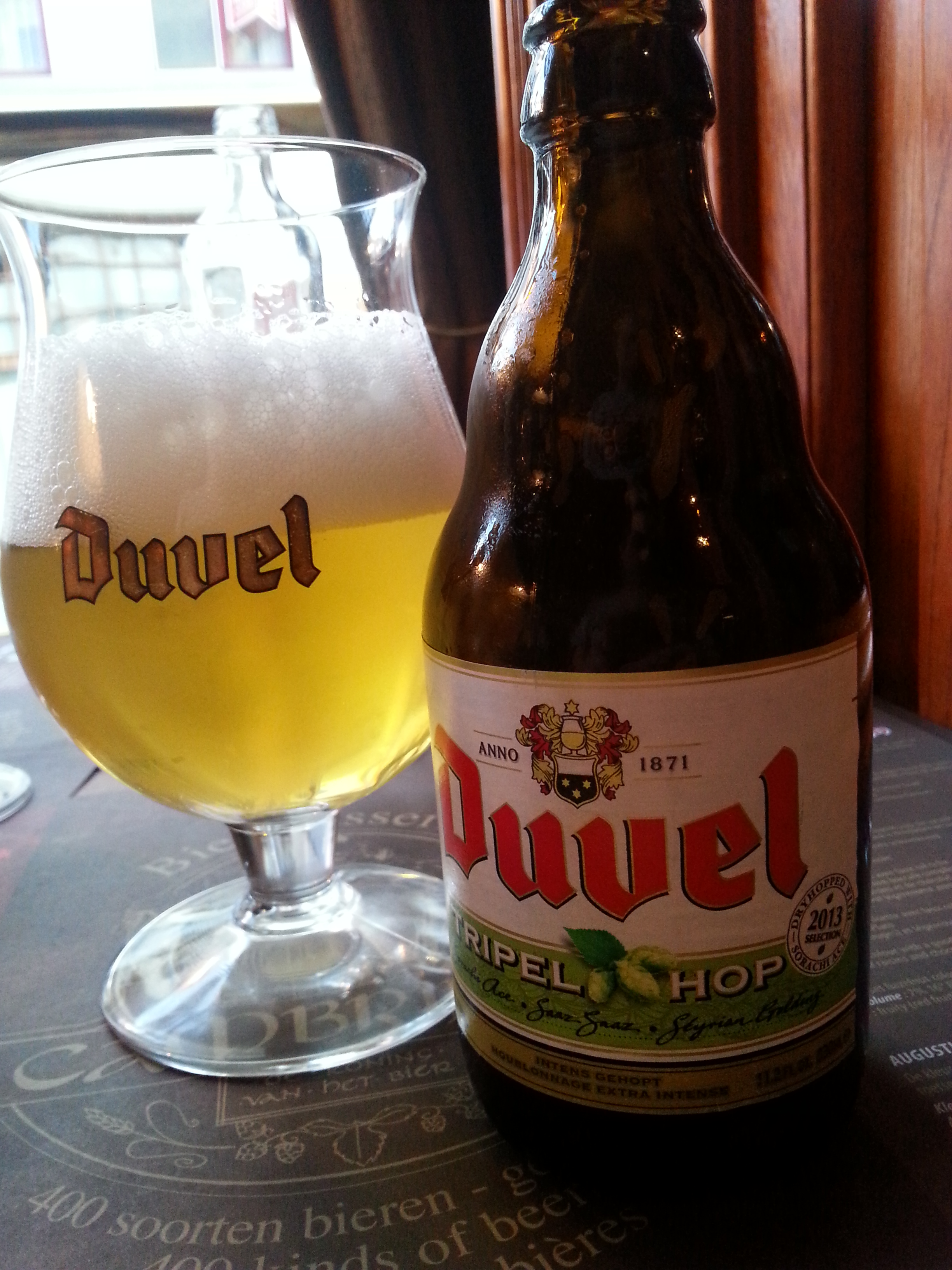
The food here was good too. Chicken and frites done simply but very well. Crisp skin on steamy chicken, crunchy fries and all washed down with the 2013 edition of Duvel Tripel Hop. Having missed the (by all accounts) sensation 2012 edition, I was eager to try this year’s interpretation. The hop bill is Sorachi Ace, Saaz and Styrian Goldings. The initial lemon/lime bittersweet balance finds depth in a silky, creamy mouthfeel, like lemon syllabub. Further in, it gains new qualities, a sharpness like a salad of peppery rocket and lemony vinigarette, before shovelling on pithy bitterness by the hop-kettle-full.
Cambrinous’ menu is large, the service is quick, and the food is good. Everything there is very reasonably priced, too, but that goes for much of Bruges. What I really enjoyed about Cambrinous was the way it remained welcoming to families and tourists, but also provided a fantastic setting for hardcore beer explorers. Everyone was welcome and the beer was fantastic.
t’ Bruges Beertje, 5 Kemelstraat
This is The Place. You can’t go to Bruges and not visit Beertje. At least, that’s what everyone says. They’re right, too. It’s a truly wonderful bar.
[Scene missing]
The problem is, I had such a good time in Beertje that I somewhat shamefully forgot to take any photos while I was there. True, a great deal of beer had taken its toll on this weary traveller, but there was more to it than that. I remember at one point wanting to take a picture of the beer I was drinking at the time, Brasserie De la Senne’s Zwarte Piet, and feeling suddenly awkward about it. Without the convenient crutch of photos to show you what it’s like, I’ll try to describe what it was about Beertje that made me feel that way.
We initially tried to visit mid-afternoon, and found the place closed. This only exacerbated my thirst, and by our eventual return several beers later, I still felt as thirsty as I had done when I’d first found the place with its doors closed and beery secrets locked away. It was a hot night, and people were just vacating a table as we arrived. Thank goodness, I thought, because I couldn’t have stood and nursed strong beer in this heat. The air was thick with a warm fug and the bubbling swell of conversation. A tiny bar somehow fills one entire wall, with liquid miracles being dispensed as quickly as they could be found.
I could see why it didn’t open until later. This place had no patience for afternoon shoppers who had wandered off the main road. This was a place for the seekers; people who know, or want to. Acolytes, weary from their travel and bibulous exertions were slumped over tables with elaborate goblets on them. We come here to pray, you see. Pray that there is more to it all than just the day-to-day grind. Beertje felt a little like the pub of collective imagination, where the barman produces the exact drink you need from beneath the bar, like magic.
This is The Real Deal, I thought, as I had on several occasions whilst in Belgium. This is It. A real tavern, like out of all those books and scenes in films. Except that the staff here, studious fellows, seem more like librarians, or guardians of some mystic archives. Indeed, so small is the bar that they often have to descend into cellars below, presumably where their arcane library is. You can test their knowledge, ask them for things like this or like that, and they’ll present you with the exact thing you need but had no idea existed. Barmen nipping off to find this, that and the other all the time? Surely the service must be very slow, you’d think? Not a bit of it. It might be because the place is so small, but the whole operation runs like clockwork.
In the back room, there’s photographs mounted above the fireplace, in memoriam to the Beer Hunter himself, a man who introduced generation after generation to Belgian beer, and the potential to have an experience like this. When I saw those photographs, and tasted what that barman gave to me, I knew. I couldn’t start clicking my camera to and fro, it felt wrong, unseemly. This is The Place.
Bruges itself is a unique marvel. I’ve been to cities and towns with historical importance, picturesque beauty, and wonderful food and drink, but very few manage to keep all of that AND be a thriving tourist destination. Many have to drop at least one of those balls. You’d think that be particularly the case when one of the best things about the place is the beer. But maybe that’s part of why it’s managed to keep it all together. Almost everything in Bruges demands that you treat it with a certain reverence, the beer included. It’s a fun place, don’t get me wrong, but it also feels very grown up, thoughtful and comfortable with what it is.
The drinking culture here is driven by tourism certainly, but with no laddish swagger or uncouth excess. Overindulgence is almost compulsory, but you are encouraged to go about it in such a classy way that it doesn’t really feel like ‘going out drinking’. You just feel like you’ve spent all day putting your palate to work, enjoying sights and sounds, and there are few better things in life than that. Here’s to keeping it classy, and having a damn good time doing so.
Next in the Beer Diary: De Halve Maan brewery, Cantillon and bars in Brussells…
View of Bruges from the roof of De Halve Maan brewery
Bruges is beautiful place. I visited it during a particularly warm spell, when every part of the city seemed lit for camera. The tourist board must do all of its promotional photographs on days like that. It’s a wonderful place to walk around, and feels like a cultural waypoint that has drawn in equal parts of England, France and the Netherlands. There’s cobbles, those very specific step-like rooftops, little delis, lace shops, chocolatiers and of course: cafes and bars, where some of the world’s finest beer is available.
I’m sure that many of you reading this will have been to Bruges. This was my first time, so please forgive me if my gleeful discoveries are all old hat to you. This trip meant quite a lot to me, because Belgian beer has always been a bit of a blind spot for me, and now, I feel like I’m so much closer to understanding and appreciating just how incredible it can be. These are the happy musings of a man who finally gets what all the fuss is about. These aren’t all the places I went to in Bruges, but they are my favourites of the places I visited. Please do share your own in the comments.
La Trappiste, 33 Kuipperstraat
Once a club and ‘rendezvous’ bar (a Belgian euphemism for pick-up joint), the 800 year old cellars on Kuipperstraat have been taken over by two men with a plan. I met the Manchester-born half of that partnership, Martin, who welcomed us into the cavernous yet cozy bar below the sunshine-bleached pavements of Bruges above.
The lighting is gentle, provided in some part by a collection of pretty, mismatched light fittings acquired from second-hand shops. The bar itself provokes memories of home, or at least the UK. Shiny T-bars and fonts spelling out more than just the usual selection of blondes and lagers. Behind, a glassware and bottle-festooned backbar display, along with that most modern of touches: chalkboards displaying their regular and guest draught beers.
The beer menus here are more than just laminated lists of names. Martin has ensured that almost every bottle beer they sell has a picture and description, to help people make wiser choices. He’s also more than happy to help guide anyone towards their ideal beer. Martin is a converter, a true believer in talking, showing and sharing. He’s one of those truly great bartenders, who goes about the day-to-day serving of great beer with a palpable sense of glee and accomplishment.
He shrugs off the bar’s commerical ties to AB-Inbev as an easy compromise. In exchange for stocking 4 of their brands, he can stock 8 other draught beers, 12-14 guest bottled beers and 80 regular bottled beers at any one time. Belgian classics like St Feuillien Blonde and Troubadour Magma were stocked alongside Birrifico del Borgo’s Re-Ale and even the likes of Bateman’s Mocha and Marble Lagonda IPA (a nod to Martin’s Mancunian roots). While many bars can knock out a range of a few hundred bottles (see below), places like La Trappiste are a rarer, more precious thing. Here’s a bar with a real conscious identity that will always be able to surprise you.
De Garre, off Breidelstraat
We visited this place twice. The first time was the best, for a few reasons. First of all, I didn’t know where De Garre was, only roughly were it was supposed to be. I didn’t know, for example, that it is down that little alley. So after several reconaissances, actually finding it was one of those proper Beer Moments ™, where the joy of finding somewhere almost equals the taste of the beer. Almost.
The second time we visited was when we were tired and thirsty, having spent the balmy evening walking the streets and finding Billy Bragg doing a free gig on the Burg Square. The first time at De Garre was still the best though, because we met great people there: a couple from Preston and an older couple from, I think, Michigan. We never learned each other’s names (though to me, the American chap shall always be Bill, given his enormous resemblance to former President Clinton). Bill was a homebrewer (in that off-handed American way, you know, he just has a whole part of his house plumbed in for it, cold store, that sort of thing, real casual) and he was talking to the couple from Preston about beer local to Bruges. I chipped in that I’d just been to De Halve Maan (coming soon to a future blog post), and everybody started talking all things beer. We had the upstairs part pretty much to ourselves, and we had a great, happy few hours of sharing beer and stories.
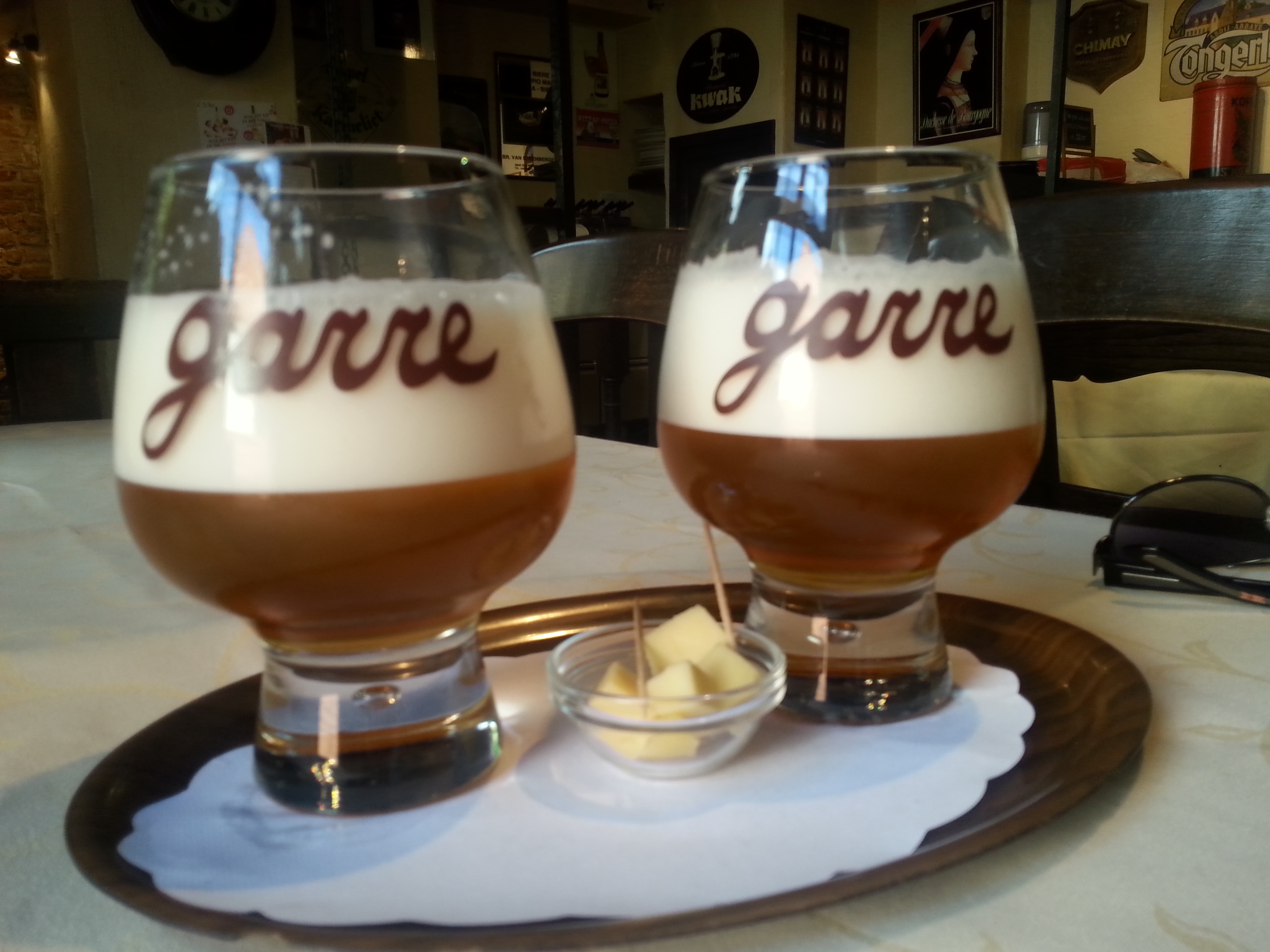
De Garre as a pub/cafe/bar is a very intimate, oak-beamed, cozy place that encourages conversation. A little too cozy, actually. The second time I was there I banged my head on the way out of the toilet. It feels almost British in layout, but naturally with a focus on bottled beer as opposed to draught. The taps should not be ignored, though. In fact, you are quite likely to be offered a glass of the house blonde beer, Tripel van De Garre, on the way in. Naturally, it comes served with some complimentary cheese. Highlights from the beer menu on our visit include Hercule Stout, a muscular 10% stout named after legendary Belgian murder-solver Poirot, and Troubadour Magma, a sort of rich, rye-super-ESB that had that trademark Belgian Balance ™ covering up its 8.2% strength.
De Garre reminded me a lot of Arcadia in Leeds, which coincidentally was where I had ‘proper’ Belgian beer for the first time. It felt quite poignant to come to the source of both the beer and Arcadia’s aesthetic inspiration. De Garre is a very warm, welcoming place, that becomes more than just bricks, mortar and beer. Its intimate atmosphere and perpetual background sound of cheerful conversation make it a charming, rewarding place with a life of its own.
















 Chris Hall | Beer
