Golden Posts 2014

(‘Beer cans’ by Michelle Tribe, from Flickr, under Creative Commons)


It seems fitting after a week when beer bloggers Boak & Bailey won the British Guild of Beer Writers’ Golden Tankard to launch the inaugural Golden Posts: a celebration of the best in beer blogging this year. As the year draws to a close, it’s been astonishing to look back and see just how much has happened in the past twelve months.

In beer itself, certain trends continue to emerge, such as the buying of smaller breweries by the very largest ones, whilst others, such as the popularity of canned craft beer, are still growing apace. Most remarkably, 2014 has seen a number of established beer bloggers find professional roles in the industry they write about, confirming not just the importance of skilled, passionate writers in the beer industry, but also the industry itself recognising such writers’ potential.

Elsewhere, there has been a noticeable maturing of the beer blogging scene in the UK. Aside from the notable winning of awards by the likes of Boak and Bailey, Pip Sprake from It Comes In Pints and Mark Dredge, there has also been a noticeable increase in the number of bloggers taking a ‘journalistic’ approach; probing for answers, seeking transparency and uncovering some surprising stories.

There have also been a number of victories in social media, when bloggers have used their influence to tackle organisations large and small over issues like sexism in marketing and questionable business practices. Whilst some of these instances have been viewed by the cynics as the ‘outrage of the week’, they are really fantastic examples of what can be achieved by enough people with the right attitude.

Anyway, without further ado, here are my winners in the first ever Golden Posts:


Best History Post: ‘The Snug Bar Preservation Society’ by Boak & Bailey (with photography by Ten Inch Wheels)

Public campaigns to save pubs or aspects of beer culture are nothing new, and this is explained with rich detail by B&B in their fantastic long read from March. It’s a great taster of their style of writing and use of sources that makes Brew Britannia such a good read, and is enriched by some absolutely sublime photography from Ten Inch Wheels. As ever in B&B’s history articles, the most interesting characters are drawn out from the period, and surprisingly familiar opinions from ages past are appreciated in a new light.

Honourable mention:

‘How I nearly found a brewery on my doorstep’ by Martyn Cornell (Zythophile) – As someone who has read a couple of books about the Opium Wars, I found this comprehensive article about the beginning of beer brewing in Hong Kong particularly interesting.


Best Impassioned Rant/Op-Ed: Brewmeister – the shame of British brewing by Richard Taylor (The BeerCast)

A category with many contenders, and hardly surprising given the nature of beer blogging. Still, the winner for me had been clear for a long time. Rich’s masterfully-written takedown of Brewmeister was easily one of the most important pieces of beer writing done this year. Flawlessly structured, with every point backed up by hard evidence, it disassembled a widely-reviled brewery with the cool professionalism of a hardened investigative journalist. A fantastic article that went way beyond being a ‘rant’ and actually effected change. (NB: there has been an update in the ongoing Brewmeister saga that shows just how far this story went)

Honourable mentions:

‘The Brewery That Cried Hells’ by Matt Curtis (Total Ales) – A heartfelt but level-headed defence of Camden Town Brewery, in response to one of the year’s more explosive clashes between two UK breweries.

‘The British beer boom: quantity over quality?’ by Connor Murphy (Beer Battered)  – A well-constructed argument espousing the responsibility of brewers to improve craft beer’s quality as well as its availability.

‘CAMRA’s Sexist Young Members Leaflet’ by Rowan Molyneux – A fierce, emotive and rabble-rousing piece that quickly became the forum of discussion on this colossal gaff by CAMRA.


Best Pub Post: ‘Sam’s Speakeasy’ by Craig Heap

A ‘fictional account’? A pub that isn’t a pub? The mysteries of Craig’s piece about a nomadic, DIY speakeasy are only exceeded by the compelling narrative and characters, and the very idea itself. But is it really fiction, are the people in it really just characters? The purpose of the piece is to spread the idea at the heart of it, which is a brilliant one indeed, and Craig’s writing is as deft and sharp as ever.

Honourable mentions:

‘The Way the West was Won’ by Andrew Drinkwater – an unashamedly lengthy love letter to BrewDog Shepherd’s Bush, but one that makes its case compellingly and celebrates people and values that are always worth recognising.

‘Zlý Časy and beer help me slip the bonds of surly life’ by Adrian Tierney-Jones – Pure poetry as ever from ATJ, but this piece in particular evoked the sense of drinking along with him, and the final paragraph is glorious.


Best Palate Post: ‘Beers Of London Series 77. Dragonfly Brewery – 2 O’clock Ordinary 4.0%’ by Justin Mason

I could have picked from dozens of excellent beer reviews by Justin, who I must admit I always had in mind when creating this category. It was this post though that really stood out for me, about a beer that evoked in him so many personal memories, which sets up the actual tasting of the beer magnificently. A lot of personal truth went into this post, and it makes Justin’s assessment a hundred times more valuable than anything as dull and dry as to be termed ‘objective’.

Honourable mention:

‘So how do you like your beer?’ by Adrian Tierney-Jones – Whilst this piece dabbles with some multimedia sensory perception, it’s that first paragraph that really shines – an unrelenting unravelling of beer vocabulary that is so pleasing to read.

 (Observation: notably fewer posts about food and beer this year. Some about experiencing it, but hardly any about suggesting combinations, recipes, stories behind them)


Best Beer Travel Post: ‘Doctor Gonzo Visits The Coromandel’ by Matt Curtis (Total Ales)

This post by Matt Curtis is part of a series about his travels in New Zealand, which are all really worth reading. As a whole they are enormously transportive and also very personal. The framing device of this piece – an encounter with local police on the beach that prompts Matt to recall how he got there – makes it stand out as the pick of the bunch, and he does a great job of capturing Kiwi beer culture.

Honourable mentions:

‘Buxton Brewery Trip’ by Per Steinar at The Evening Brews – more than ‘just’ a brewery trip blog post, Per’s journey to Buxton, around the brewery, the town and its pubs, is just that: a journey. Packed with stories and retains a narrative feel to it.

A series of blog posts about Nuremberg and Bavaria by The Beer Nut – Best enjoyed in one sitting (accompanied by multiple glasses of German beer), this information-rich series of posts shows an impressive amount of note-taking fuelling TBN’s newspaper-quality travel writing.


Funniest Post: ‘The future of Craft beer? Be careful what you wish for’ by Richard Taylor (The BeerCast)

Projecting a dark future timeline where craft beer unravels the UK into an IngSoc society of craft beer totalitarianism, Richard perfectly skewers the the best and worst parts of beer culture in a piece that shows the author knows beer and dystopia inside out.

Honourable mention:

A return to Rapture, Cardiff’s first underwater bar by Craig Heap – One for the gaming beer geeks among us, this post (and the previous installment) is a pure nerdgasm crossover of the world of Bioshock and the world of craft beer. Would you kindly read it?


Open Category: ‘Pilsner Urquell tour: the men who invented lager’ by the Craft Beer Channel

Whilst I’ve been a fan of YouTube’s the Craft Beer Channel for about as long as it’s been going, I think this video from Jonny and Brad’s trip to the Czech Republic is easily one of their best. It has a great sense of narrative to it, entertaining hosts and great content from start to finish. It’s a sort of brighter, more humour-adept version of one of Michael Jackson’s The Beer Hunter programmes, which is no mean feat.

Honourable mentions:

‘The A to Z of Beer’ by Jamie Oliver’s Drinks Tube (featuring Jonny Garrett and Sarah Warman) – Also featuring Craft Beer Channel’s Jonny, this video from the Drinks Tube brand of the Jamie Oliver network of YouTube channels delivers a fun and accessible series of bite-sized bits of beer information with engaging presenters and a sense of humour.

‘The Vine Diaries’ by Matt Curtis (Total Ales) – A savage journey to the heart of the European Beer Bloggers Conference in Dublin, Matt’s video stitches together every Vine he made on the trip into a 12 minute film that is both magnificent and yet mildly harrowing (for those involved). Warning: contains drunk bloggers throughout.

Well, that’s it for this year. I’m looking forward to seeing what other blogs get recognised by you lot, and I’m hoping that whilst there is some crossover, we’ll all share some pieces that others have missed out on. Oh, and maybe I’ll come up with an actual logo for next year. Cheers!

If you want to take part, post your Golden Posts blog and tweet it at me (@ChrisHallBeer) and/or with the hashtag #GoldenPosts and I’ll include it in a round-up at a later date.
Salopian

2014-09-14 14.54.59

I’m extremely late to the party on the appreciation of Salopian Brewery’s beers. So late in fact, that when reading up about them as research for this post, I came across Mark Dredge’s post about how late to the party he was, over a year ago.

In which case, I might be saying a lot of things that a lot of you already know. Perhaps not, though. Perhaps Salopian have been on your radar for a fairly long time too, and the opportunities to try their beers have been few and far between, if at all.

It was GBBF that finally got me a taste of Salopian’s beers, though not initially in the normal way. Darwin’s Origin, their best bitter, won Silver in the Champion Beer of Britain competition, and Hop Twister, Lemon Dream and Shropshire Gold were also available, unprecedented (in my short memory of GBBF) for a brewery without its own bar. Unprecedented perhaps, but telling. In reply to someone else’s  tweet about how good their beers tasted, I said that I’d missed out on them on Tuesday’s trade session, and assumed that by my return on Saturday, they would be gone, as most of the award winners tend to be.

I was then contacted by Jake at Salopian, who kindly offered to send me some beers to try, as, in his words, he’s keen for people to see what they can do. As it happened, I did manage to get a taste of Hop Twister at GBBF’s Saturday session, and I was duly impressed. Pithy, tangy citrus and juicy too, on a light and crispy body reminiscent of Jaipur or Kipling, with conditioning many of the beers around it at GBBF sadly lacked.

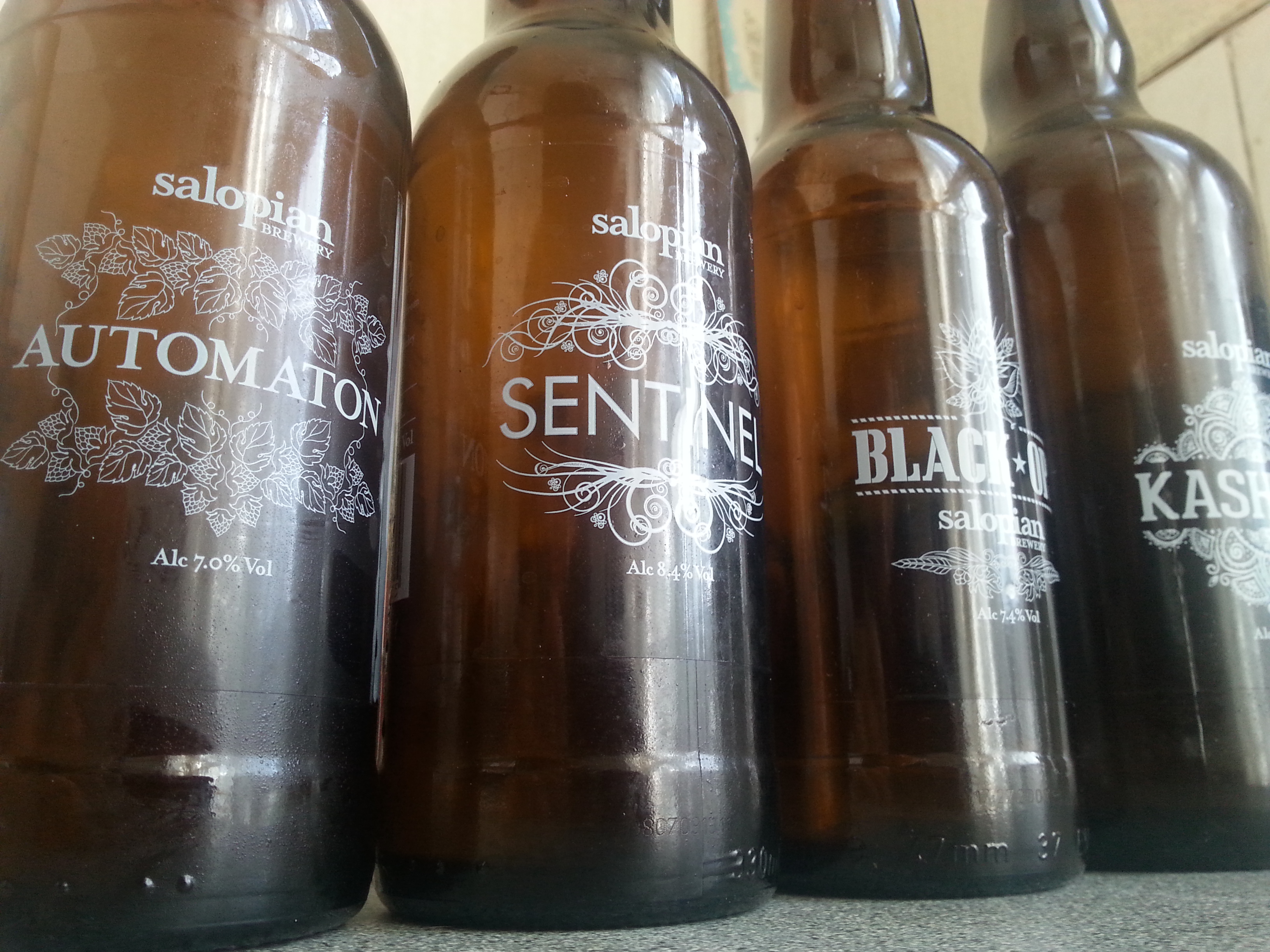
When the box from Salopian arrived, I was stunned by the range of beers being produced. Aside from the, shall we say, more conventionally labelled core beers like Oracle and Darwin’s Origin, a squadron of minimalist, silver printed bottles made up the numbers. Names like ‘Kashmir, ‘Kinetic’, ‘Automaton’ and ‘Black Ops’ spoke of several shades of IPAs, noting the hops used but little else about them. I would have preferred a little more blurb, if only a few words to say the intended style or twist on it, but the sense of mystery certainly did make me want to open them.

Automaton, a 7% IPA hopped with the unlikely odd couple pairing of Citra and Saaz, was like a magic trick. Pulped grapefruit and mango soak the palate one second, then disappears with a peppery dryness the very next. That juiciness I seek in hoppy pale ales was present in every one of Salopian’s pale ales and IPAs, even the black ones. I was impressed perhaps most of all though by the simple elegance of core pale ale Oracle, which had a glorious peach and melon flavour to it, in a 4% pale ale whose label couldn’t look more traditional. If you’re lucky enough to find these beers near you, do not hesitate.

It got me thinking about how we judge beers not just by flavour, appearance and if it lives up to its reputation, but also by whether we were surprised by it. Some of the beers and breweries that have impressed me the most have been one that completely wrong-footed me. The fact that Salopian’s beers are less easily available  in London contributes to this somewhat, but I don’t think they should remain this elusive. Far from it. I want as many people as possible to be disarmed by the simple brilliance of their beers. I count Salopian in the most important category of breweries: those that simply are a craft brewery, without needing to say so.

Do you have a favourite brewery that aren’t that far away and yet you hardly ever seem to see their beers where you live?

These beers were sent to me by Salopian out of generosity, not in exchange for a blog post, which was written purely on the strength (or rather the quality) of the beers.

The Golden Tiger

u Zlateho Tygra


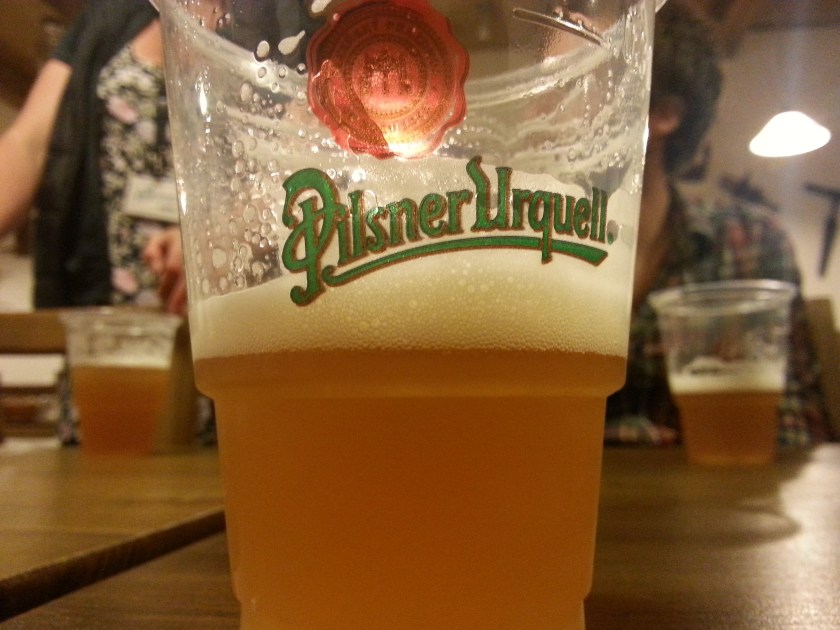
Another pint of Pilsner lands on the table and another mark is made on our card. The server plonks down further pints wherever a glass is in danger of becoming empty, or rather, less than 1/4 full. He then returns to his place at the bar and starts pouring again. Every now and again a tourist will enter and try to order at the bar, only to be told in Czech to ‘sit the f*** down’ (if, indeed, a seat is available). This is more than table service, this is fresh pints on demand before you even ask for them, at Prague’s U Zlatého tygra (The Golden Tiger).

Once more, our mugs of fresh Pilsner clunk together with the satisfyingly hefty sound of marble statues butting heads. Syllabub-like foam packed with fragrant hop oils gives way to the bright, sweet and sharp palate, and conversation fills in the gaps between mouthfuls of beer. The Golden Tiger is pure beer culture, and whilst it is quintessentially Czech, it is a pub that anyone in Northern Europe will find both immediately familiar and refreshingly simple.

As it’s such a singular pub in Prague, it’s fitting that there’s only a single beer available: Pilsner Urquell (40 Czech krone or about £1.15 for 0.5l). In the UK, such an arrangement would typically indicate a heavily branded corporate lounge, the kind typically seen in lager adverts on TV. In reality, The Golden Tiger has more in common with my dad’s village boozer, including its grudging acceptance of non-locals proving they don’t take up too much room. It’s almost exclusively populated by men, sat shoulder to shoulder around long tables on long benches. The walls are decked with Pilsner breweriana and coat hooks at frequent intervals. Vaulted ceilings, stained glass and golden iconography suggest a religious following, but it just feels so pubby. You come in, you take your coat off, you sit, you drink. Eventually, you might leave, but the beer is just so good.

Unlike so many before it, Pilsner Urquell itself has been left largely untouched by the takeover of a multi-national. Here in its homeland, it is enjoyed by the half-litre with a good inch of head, and drank fairly briskly. Czechs believe the beer’s character dies the second its head recedes to expose the beer beneath to light (about twenty minutes), and would rather order another pint than sup the imperfect dregs. That zealous attitude towards beer, appreciating it through drinking it, is truly Czech.

The building the pub is in dates back to the 14th or 15th century, and there is record of it as a beer hall from 1816, thought it is likely to have been in similar use earlier than that, since it gained its distinctive wall relief of a tiger in 1702. It has gained a storied history and a reputation for truly ‘democratic’ drinking (the mayor sits beside a common labourer, who sits beside a famous writer, who is chatting to a visiting Bill Clinton and so on). But unlike many other extremely old pubs I’ve visited, The Golden Tiger feels like a real pub, not just an interactive museum exhibit. I try to judge these historic places in much the same way as a pub built yesterday: not on what it’s supposed to be like, or what its history is, but what it’s like right now, that very moment as a take my seat with a beer.

Pubs after all are buildings that generate atmosphere, whether they intend to or not. Controlling that atmosphere can be difficult and depend on myriad criteria, but that tangible sense of vibe and energy and other such words is what defines the place. The Golden Tiger, with no eclectic beer range or unusual concept relies almost solely on its atmosphere, which is incredible. It actually seems to breathe somehow, with life and noise and beer, and I think that has a lot to do with the rhythm of the place.

As a party arrives and takes seats, the server arrives with a sufficient number of pints of Pilsner and places a piece of card with the equivalent number of marks on it on the table. As more pints arrive, more marks are made on the card. To end the cycle, one must almost physically arrest the bartender in the act, and make it clear that you want your bill settled. Yet most of the time, when the chap returns, looks that say “one more?” are exchanged, answered by the thunk of more mugs of beer. That rhythm of beers hitting the table and the burble of conversation becomes a sort of music, a soundtrack to a flawless scene played over and over for everyone’s enjoyment.

Out of the corner of my eye, I see a man arrive and hang his shiny, multi-coloured tracksuit jacket on the coat hook. On the hook next to it he hangs a thin, flimsy red-and-white striped plastic bag, universally a symbol of a market purchase. He nods greeting to his friend, then looks over his shoulder as if to check his freshly-bought treasures are still there. I can see them through the thin bag: several vinyls, the one at the front bearing the logo of Def Leppard. This is probably one of the chaps Bill Clinton chatted to. I can just tell. I look back to my beer, and on cue the barman arrives with more mugs of Pilsner.

That moment left a strong imprint on my mind. When I reach the last few gulps of a great pint of Pilsner now, wherever I might be, I wonder if I’ll see a golden tiger at the bottom, a glimpse of a Def Leppard record, and look to see if someone is bringing me a fresh glass.


U Zlatého tygra

Husova 17
110 00 Praha 1
Česká republika

My trip to Prague was sponsored by the generous hospitality of Pilsner Urquell and Mark Dredge, their Beer Correspondent.

Designed To Be Human


IMG_20141102_163338

Big Beer is trying its hardest to take the lead in igniting the nation’s appreciation of beer. The thing is, aren’t we all managing without them?

Let There Be Beer, the much-maligned joint campaign by Britain’s biggest brewers, has had a facelift and, as its organisers have put it, has ‘evolved’ (like a Pokemon) into There’s A Beer For That. It’s not for me to say whether a phrase trademarked by Apple in 2010 being appropriated by Big Beer is a legal concern, but like the rest of the campaign it sadly reeks of someone else’s hard work passed off as something new and important.

The campaign’s press launch on Wednesday (attended by industry execs, press, MPs and two bloggers – myself and Matt Curtis) showed the biggest elements of the industry patting themselves on the back, certain that they had found a way to take back the dastardly creeping margin of craft beer that’s been making them all look bad.

Before I arrived at the fog-shrouded obelisk of Millbank Tower on Wednesday evening, I had truly wanted to like what they were going to show us. I met people representing the campaign back in June at the European Beer Bloggers Conference in Dublin, and, with perhaps the social lubricant of a few beers boistering my resolve and softening my cynicism, I along with a few other bloggers gave them a substantial amount of free advice about how to make their campaign better. The main points that we each made revolved around the importance of being inclusive, sincere, friendly and knowledgeable. The resulting campaign shoots at least for some of these aims, but misses every single one.

For one, there’s a curious amount of doublethink at the heart of the campaign. On the one hand, by the campaign’s own admission, Britain’s beer scene is booming, with more interest in beer and brewing than ever before, but at the same, they believe the British beer scene needs ‘reigniting’ and ‘rejeuvenating’. So, is it booming or not? The only things in need of reigniting and rejuvenating in the British beer scene are the tired attitudes and beers of 90% of the market. Now, that 90%, the representatives of which were sat around us in the function suite at Millbank, has now put £10million into playing catch-up under the guise of presenting a united front for all beer in Britain.

To be absolutely clear, the craft breweries leading the way in including and engaging people about beer have no need for this campaign, nor are they likely to want be associated with any of the breweries that have formed ‘Britain’s Beer Alliance’, the loose association funding the campaign (the British Beer and Pub Association, Heineken UK, Carlsberg UK, SAB Miller, AB Inbev, Molson Coors, Enterprise Inns, Shepherd Neame, Cask Marque, IBD, Everards, the Beer Academy, SIBA, Robinsons, Fuller’s, Liberation Group, Thwaites, Budvar, Charles Wells, Wadworth, Daleside and It’s Better Down the Pub). The involvement of SIBA as an organisation does not mean that any of the breweries it represents are a part of this, or that they support it. Britain’s craft breweries are already reaping the benefits of their own hard work, and now the big boys are trying to reap the benefits of the craft brewers’ hard work, too.

It was blatantly obvious from the launch event that the big brewers are scared, genuinely petrified, of the success of craft beer and small breweries, and they’ve decided to join forces, again, to present themselves as something just as credible and interesting. The sales and marketing language used to explain the Alliance revealed more than perhaps they intended. Britain’s Beer Alliance is so desperate to be a mainstream, UK version of the US Brewer’s Association that it has mistaken values and principles for a sales strategy and an advertising campaign.

The campaign’s new advert, made at great expense and involving the talents of British director Michael Winterbottom (of ‘The Trip’) and a production team including those who worked on the 2012 Olympics opening ceremony, is very much of the homey, down-to-earth, pushing-bike-up-a-hill school of advertising last seen in Hovis commercials and more lately given a new lease of life by McDonald’s. A friendly, pan-national accented voiceover reassures us that whoever you are (as long as you fit into advertising’s designated people-pigeonholes), there’s a beer for you. Or, as some have noted, perhaps a burger?

The advert has one thing going for it: it tries to show Britain’s diverse population enjoying a beer as ‘normally’ as possible in as many ways as possible. Unfortunately, as is the way with adverts, it seems so contrived that there is no question of whether it’s ‘natural’ or not. Picture-perfect pints with industry-benchmark levels of head sit untouched in most scenes, with only a few of the actors shown to be brave enough to take a cautious sip. All it shows is that, whatever the cuisine, there’s an unwanted prop beer for that.

Whilst the stated intention of the campaign might be to promote the interests of all beer, the number of beers it chooses to promote in the TV advert is curiously selective. Note, for example, the absence of any stout or black beer, and the absence of Diageo (owners of Guinness) from the so-called Alliance behind the campaign. Unlikely to be a coincidence. This is about self-interest, nothing more.

Some might argue that regardless of the intentions of this campaign and its backers that the industry still needs such a ‘call to arms’ to help Britain’s beer culture to be taken seriously. I’m not sure that we do need a blanket, carpet-bombing campaign like this to achieve such an aim. Only the night before the launch of the campaign, I was at a beer and food dinner organised by Beavertown, Dogfish Head and Wells & Youngs. This combination of cutting-edge British youngblood brewery, American inspirational trendsetter and established British cask ale bulldog resulted in a wonderful evening that represented the very best of what beer can do, with warm and engaging hosts. People with all levels of beer knowledge left that event with big smiles on their faces and zero doubts about what beer can do. Events like that are taking place across the country on a regular basis, and more people are trying more beers from more breweries than ever before, without the help of Big Beer.

For the astonishing £10million pounds being put into There’s a Beer For That, a handful of quality bars or pubs could have been bought, refurbished and used to showcase the most impressive beers this ‘alliance’ of breweries has to offer. Imagine a bar with Fuller’s Vintage, Worthington White Shield, Young’s Special, Shepherd Neame’s IPA and Double Stout, Courage Russian Imperial Stout and more besides all being stocked alongside each other and served with great food by TV chefs, with interested celebrities making appearances at festival events and dedicated TV spots. Done right, something like that could have seemed so much more sincere, interesting, welcoming and capture the imaginations of people considering beer as more than just pints of lager and bitter.

Instead, what we have is deep-pocketed porno for a dumbed-down version British beer culture, something that is pleasant enough to watch, but is devoid of meaning and intent. Sure, a handful of pubs promoting great beer and food to the public might not reach as many people, but shouting BEER at the whole country with a flimsy message for £10million isn’t going to change anything at all. Rest assured that we will be having this conversation again in three, five and ten years’ time, as the giants of the industry try again and again to save their blandest beers from gradual decline.

On top of that, the digital side of the campaign (including a new website which has taken enough of the design of Good Beer Hunting to be concerning) seeks to make the same mistakes as Let There Be Beer, but more expensively. A social-media-based food and beer matching bot will respond to people using the appropriate hashtag, and attempt to match a beer from its database to the words used by the user. We were supposed to be reassured by the fact this bot has been, in their own words, “designed to be human”, but it ‘s hard to see how it won’t simply be broken to pieces by Twitter in a matter of days.

Can this bot distinguish between “I’m having a Sunday Roast and I want a #beermatch” and “It’s hot today so instead of a Sunday roast we’re having prawns from the BBQ and I need a #beermatch” or “The pub has sold out of Sunday Roasts so now I’m having a pulled pork sandwich and need a #beermatch”? It’s certain to end in disaster, or at best, some high parody.

I know that I’m a beer geek and that this campaign isn’t designed to impress beer geeks. I completely understand that. However, this campaign is designed to impress people who aren’t beer geeks, and it won’t. It will pass by the people it’s trying to win over, and fail to sustain the interest of those that give it a chance.

Whilst I’ve made it plain that I don’t believe in the campaign for one second, I should make it absolutely clear I believe that some of the people involved truly do believe in it. However, whilst they are convinced that this is the way to change the face of the public’s appreciation of beer, this is already happening without Big Beer’s involvement, or its attempts to steer the appreciation of beer to its agenda. I cannot and will not be convinced that it is anything more than the largest beer brewers and companies attempting to trade on the credibility and integrity of the smallest.

Whilst the national beer market is gradually declining, the craft beer market keeps on booming. The message is clear: the number of people enjoying good beer is rising, and fast. The largest, slowest and blandest are now trying to reclaim territory they have lost to far more interesting drinks, craft beer included. They are trying to prove they care the only way they know how, by creating artificial things designed to be human, to promote industrial beers designed to look more craft. They are trying to fool us all into believing that they care, fool us into believing that they have good beer’s interests at heart. They won’t succeed, because despite all their money and influence, there isn’t a beer for that.


Further reading:

– Matt Curtis spits fire and reveals his previous interactions with the PR company behind There’s A Beer For That

– Craig Heap explores the similarities between the new ad and recent ones by McDonald’s

– Ruari O’Toole looks at the ad in the context of the difficulty of advertising beer in the UK

Pete Brissenden provides some sharp criticism and offers perspective from the smaller end of the brewing industry

Electric Citrus: the rise of the Juicy Banger


'Drink citrus fruit juice' by David Lisbona, from Flickr, under Creative Commons.
‘Drink citrus fruit juice’ by David Lisbona, from Flickr, under Creative Commons.


The more of them I drink, the more I realise they have something in common. Whether ale or lager, 3% or 6%, a loose new category of beer is beginning to form from the current new wave. It’s a less of a style and more of a statement of intent, and a demonstration of skill that will come to define the current crop of craft brewers in the UK.


In London we are blessed with a high number of breweries, true enough, but it’s the sheer number of beers available that really blows me away. As I’ve said before, the city seems to thirst for the most esoteric and newest things it can find, and it’s no different with beer. Lately though, it hasn’t been the barrel-aged saisons, imperial stouts or even the increasingly impressive range of quality lagers and finely-tuned sours being made in London that have impressed me the most.

A label I apply frequently when referring to juicily fruity, tartly bitter IPAs and pale ales is ‘Juicy Banger’. It’s been pointed out to me that it sounds like something unsavoury said on The Only Way is Essex, but I continue to use it nonetheless. It captures in two words everything I look for from my first beer of the night: a full-bodied but brightly refreshing, finely-balanced beer of big flavour yet peerless drinkability. It’s become a hallmark by which I measure a brewer. If they can brew a Juicy Banger, a beer loaded with assertive, juicy hop character but one I could happily drink all night, and by the pint, then they’re all right by me.

Beavertown’s Gamma Ray and Pressure Drop’s Pale Fire, arguably leading the field of Juicy Bangers in the capital, each have tribe-like followings. The joy with those beers, Pale Fire in particular, is trying it every time you see it, and detecting the growing ability and confidence of the brewers as they dial it in ever tighter and tighter. Gamma Ray went through a similar period of improvement, and now, as those immediately iconic cans roll out of a bigger, better brewery in Tottenham Hale, it has reached its zenith. This is key: we aren’t just brewing more beer styles, we’re brewing better beers.

It’s now got to the point where I think of Juicy Banger as a style in its own right. Perhaps as recently as a year ago, I would have simply thought of them as pale ales and IPAs, but not anymore. Not since Camden Town Brewery’s Indian Summer Lager, and its genetic successor IHL (Indian Hells Lager). Each have their roots in the same brewery’s USA Hells, but it’s those two newer beers that have for me redefined what kind of beers we can make in the UK. These aren’t just hoppy beers, they are astonishingly balanced lagers delivering the hop hit of the most accomplished IPAs. I had the pleasure of trying a few cans of IHL at a recent canned beer competition in London, ahead of its official launch in a few weeks’ time. It is hugely impressive, not only in terms of its High Definition, bright, electric citrus flavours but also its finely balanced body. It might be the best beer made in London.

More generally, it would appear that the trend for brewing the palest possible ales to showcase hops (arguably started by Thornbridge with Jaipur and Kipling, correct me if you know different, and I don’t mean ‘golden ales’) has reached a sort of logical extreme, or another, further branch on the evolutionary tree: these pale ales have become lagers. This decade’s definitive beer style, the one that we will be able to identify with certainty in 5 or 10 years time, will not be an IPA or a saison, but a pale-as-sunlight, hop-forward beer that demonstrates true brewing skill, whilst remaining accessible enough to recruit new fans of craft beer and be sunk by the pint in bars across the UK.

For the time being, this field is populated almost entirely by American Pale Ales and IPAs, but I predict others will take up the challenge implicitly laid down by Camden Town and pitch their own spin on IPA/pale ale/lager hybrids.  Several already exist: Weird Beard Citra Pilsner, Williams Bros Caesar Augustus and Adnams Jack Brand Dry Hopped lager just off the top of my head. Even Fuller’s have had a go at it in the form of Frontier. Plus, as if to prove the lines between ale and lager blurring even further, Beavertown and Camden recently brewed a collaboration lager combining the body of Camden Hells and the hopping of Gamma Ray: One Hells of A Beaver. It, needless to say, is a Juicy Banger, but astonishes me mostly because it marries the body of Hells and the hop character of Gamma Ray seamlessly. So if whether it’s an ale or a lager doesn’t really matter, how then, by current criteria, does one know a Juicy Banger? Here are some recurring factors:

Fresh – Freshness is important now more than ever before, as an increasingly connected world becomes less tolerant of delay and any potential inhibitor of flavour. As the newer craft brewers expand, it might also be that to improve freshness they sell this beer in a:

Can – It’s not perfect, or the messiah of craft beer, but the can has a lot going for it, not least the tendency to feature stunning designs that open people’s eyes to what beer can be. Whilst it’s not essential to be canned to be a Juicy Banger, it doesn’t hurt. They #can also be very good value, especially if they are sold:

Local – A criterion hand-in-hand with (but not the same as) freshness. JBs are typically enjoyed just a few miles from where they are born. Local identity is big part of enjoying these beers. Whether local or not, they absolutely have to be:

Pale – Whether lager or ale, these beers have to be golden or very pale amber. They can be hazy, even on the murky side, but they absolutely must be bright and glowing with mischief. The simplicity of the malt bill allows the brewer to show off their ability to make these beers:

Hoppy – Whatever you think of the word, it’s the most immediate and shortest descriptor of what these beers are. Typically we expect a cocktail of American hops, but other varieties are welcome, as long they help make the beer taste:

Juicy – Juiciness is more than just fruity flavours, it’s like those fruits have just been bitten into, the sweetness and acidity biting back. Juiciness demonstrates the mastery of hopping, the freshness of the flavours, and makes these beers:

Pint-able – If it isn’t in a can, or even if it is, it should be able to be bought locally on draught. Just a half or third of a pint of one of these beers makes you wish you ordered a pint.

Why do I think these beers are so important, and distinct, from existing styles? Well, I think we’re increasingly constrained by beer styles, and their names, and the criteria that sets back innovative beers in homebrewing competitions but celebrates dreary and by-the-numbers ones. American brewers are so locked into terms and categories that when they brewed lighter alcohol beers that still had huge hop bills, they called them Session IPAs. The beers seemingly couldn’t stand alone – they needed some kind of label as a crutch to justify their existence. I think, and hope, we’re moving past that, and I think specific beers are starting to become styles in their own right. That is, after all, how most beer styles tend to come about. Hopefully, history will judge this latest one by a better moniker than Juicy Banger. In any case, they are beers we need, and deserve.

Buried Deep: Pilsen and Pilsner Urquell

2014-09-04 16.34.19

Back in September, I was invited to visit the Pilsner Urquell brewery by Mark Dredge. Whilst there I had a number of Beer Moments, and one of the biggest was had at the brewery itself in Plzeň, Česká republika (from here on: Pilsen, Czech Republic).


The cellars below the Pilsner Urquell brewery seem to go on forever. Some are collapsed, some chained off, others perfectly intact. One cavernous room once held tonnes of ice, the meltwater flowing through the cellars and the air recirculating to maintain the ideal lagering temperature. These cellars, covering the same area as the town-sized brewery complex itself above ground, would have been just as busy if not busier than the brewery above. A hundred years ago, the thunder of rolling oaken vats would have been the soundtrack to the work of 7000 coopers making 5000 wooden barrels a day below the earth.

Back in 2014, it feels like walking through the bones of some dead leviathan. There are five miles of these tunnels, twenty metres below the ground at their deepest. It’s so easy to think of breweries as a living thing – their veins and arteries pumping lifeblood from one metal organ to the next, procreating in its own unique way – but down here in the cellars, there’s something more crypt-like and supernatural in the atmosphere. Not a sense of death, but of life after death, returning ever stronger, keeping some spirit of what it means to be Pilsner alive in the soul of every oaken timber of every 40 hectolitre barrel. We are warned about the Devil In The Cellars – a ghoulish rock formation down here that’s currently chained off for undisclosed safety reasons.

Our group is led through the darkness by Robert Lobovsky, a native of Pilsen who, after spending his formative years abroad, returned to his homeland and petitioned Pilsner Urquell to give him a job. His job now (Beer Master) is to tell the beer’s story around the world, the story of a beer that to him was part of his Czech identity when he was growing up in Australia. To be Czech means to be from a nation of brewing, and the creation of Pilsner is the Czech’s gift to the world.

On a hill at the highest point of the brewery site, and the city itself, stands a 100 metre high water tower, containing two vast metal tanks that once held the brewery’s water. Below that tower, the ground is seeped with ancient blood. As the highest point in the city, it was the favoured spot for public executions in bygone ages. The brewery’s water is still drawn from the same 100 metre deep well nearby. We joke that the blood and bones of traitors gives the beer its distinct taste but it was that simple, soft water, drawn from 100 metres below ground to sit 100 metres above it, which became the body of one of the world’s most important beers.

Pilsner’s beginning is an unusually precise one in comparison to many other beer styles. I’m so used to bookending historical accounts of beer’s origins with ‘Sources indicate…’ and ‘…or so it is believed’ that Pilsner Urquell’s story seems starkly rigid and underlined in fact by comparison. For one, we have an official origin story for our opening scene: the burghers (property owning citizens) of Pilsen pouring away 36 barrels of beer in the town square in protest against the poor quality brews being made, and forming a co-operative venture that built the brewery used by Joseph Groll to brew the first pale lager beer. We even have an exact date when the first batch was ready and tasted: 11 November 1842. It all seems so black and white – and I have read criticism of this origin story – but as stories go it remains compelling.

Back in the cellars, it’s with barely concealed excitement that I pour myself a glass of unpasteurised, unfiltered Pilsner from the 40 hectolitre wooden vat. These things weigh a few tonnes even when they’re empty,  and every gram of that weight and every year of this beer’s history is weighing down on my mind and on my fingers as I turn that tap handle. It pours like frothy milk at first, eventually churning into a hazy, golden syrup-coloured liquid bright with life. I hold the glass to the dim lights in the cellar, peering into its thick, cloudy, burnished gold colour, topped with an ice-cream scoop of foam the texture of whipped egg whites. I’m expecting something special. Of course I am. Its silky, luscious palate disarms me, that dab of butterscotch so important to its character becomes caramel, then lemon tart, but there’s also a gripping, oily, herbal bitterness that lifts the entire palate up to meet it. It’s raw and alive. It’s perfect.

So much is said about the authenticity of the beer, how closely it compares to its original iterations, with the same culture of yeast, triple decoction, wooden vat maturation and so on. Up until the moment I tasted the beer, it was all I could think about: I wanted to be sent back in time with a sip, to understand and truly comprehend a moment of flavour from a bygone age.

When I tasted it, all those daydreams were shattered, blown to pieces by the sheer excellence of the beer in the glass. We returned later for more, and all I could think about that second time was not how amazing that beer must have seemed the first time it was made, but just how amazing it tastes right now. That’s why a portion of Pilsner Urquell is still matured this way, to taste-match the conventional batches matured in metal, so that they know it still tastes the same.

Like the cellars, this beer’s legacy seems to go on forever. It was the first pale lager beer, so it had little competition at the time, but in the lager-soaked present, it remains head and shoulders above so many lesser Světlý Ležáks (other Czech pale lagers) it shares a country with and the hundreds of foreign imitators. It remains The Pilsner. It’s buried deep.


Of course, there’s a great deal more to Czech beer culture than just one beer, and I’ll try to cover more of it in a couple of future posts. Thanks to Mark Dredge and Pilsner Urquell for their hospitality.

The Emperor’s New Zwanze

IMG_20140920_201603

A belated post about Zwanze Day 2014, hosted in London this year by The Kernel Brewery on 20 September.

I’m not entirely comfortable with pronouncing the word ‘Zwanze’ – one way sounds too much like Swansea or ‘onesie’ (and I think Zwanze Onesies would be the definitive indicator that we’ve reached ‘peak craft’), and the other way of saying it just sounds like a word for futuristic swans. However you say it, it’s the name given to the day celebrated annually when a unique beer brewed by Cantillon is released and enjoyed at various locations around the world, with all kegs being tapped at 9pm Belgian time, wherever it is in the world it’s being tapped.

This year was the first time I’d attended a Zwanze event. I’d been to limited-release-beer launches before though, so I expected a heaving crush of people swarming around a tiny bar, each with a camera-flashing phone in one hand and a artisanal teku glass sloshing enamel-stripping megabeer in the other. I was especially concerned given how busy The Kernel Brewery bar can be on Saturdays (for the Bermondsey Beer Mile) that it could be chaos.

The reality was a very civilised affair, far more calm than a Saturday day session. This a limited list, after all, of people who had registered by email for a glass of this singular beer. It was a simple and effective system: register by email and receive a flyer on arrival entitling you to a glass of Zwanze, so no worries about it running out whilst you’re queuing.

The story of this year’s Zwanze can be found here. It’s a lovely story, and the beer itself has a very considered yet playful construction that really embodies the mind of its creator. Briefly, it’s a three-year-aged, blended, dry-hopped gueuze, blended with kriek and dry hopped again with Bramling X. Reducing it to a sentence does the beer a injustice though, because the canvas it paints across your palate is so much more than its constituent parts.

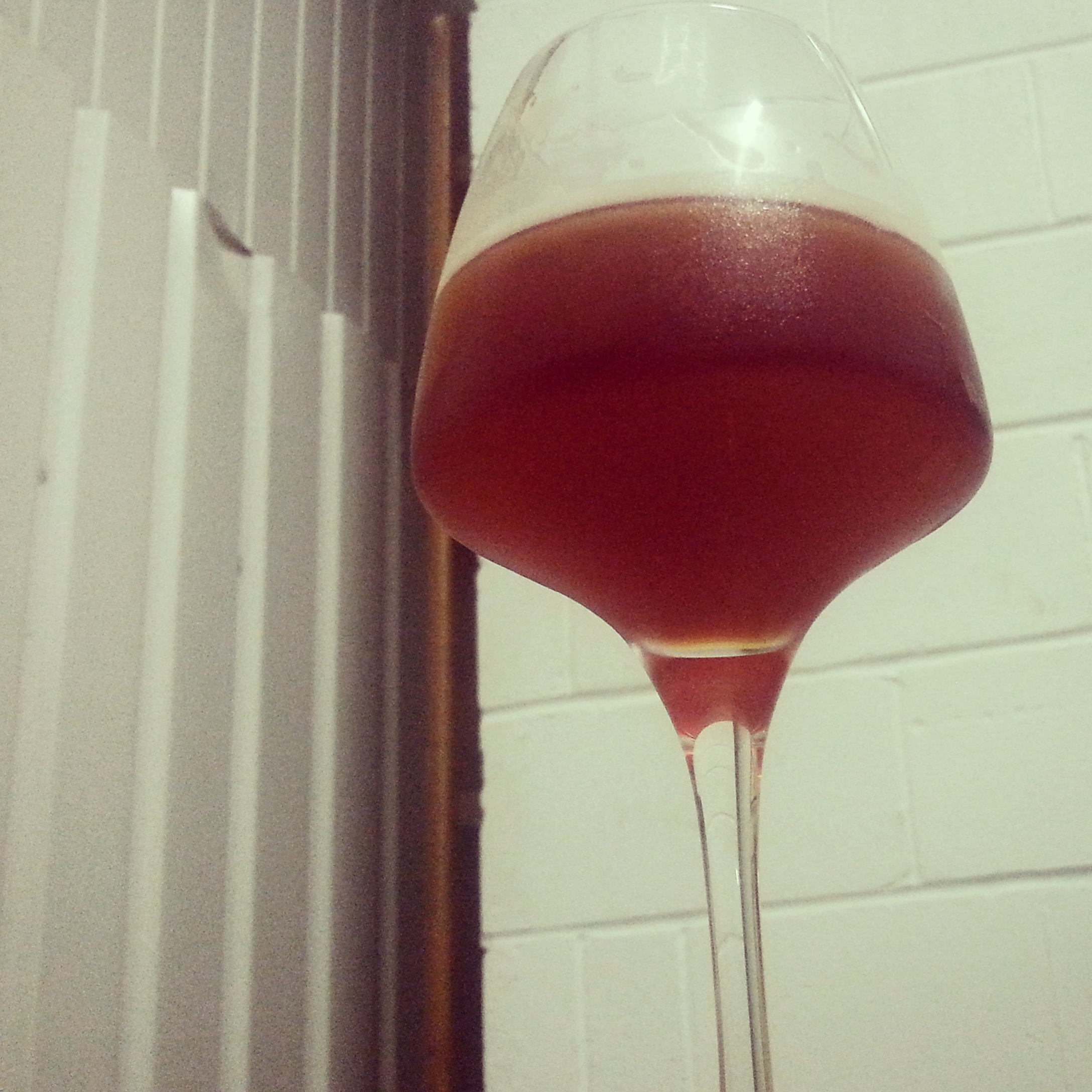
The colour alone, a mahogany-rich maroon with carmine edges, thrills the eyes. The sharp aroma of citrus pith, pepper, linseed oiled cricket bats, leather and overripe blackberries is, at first, baffling. You need a taste to complete the puzzle it presents. The first sip is an artillery barrage of harsh, flat, funk, wrapped in juicy, tart luscious raspberries and white grapes, thicken by the thick cut shred of orange peel in marmalade that gets stuck in your teeth. The finish, more of a crescendo really, is a machine-gun bitterness that sprays around the palate and dries everything it touches with lemon pith, apple skin and wood. Oh, and it is sour – sour like the sky is blue – but it was the dryness that really stuck with me, remarkable and utterly brow-furrowing in its assertiveness.

Of course, with every event like this, there is plenty of commentary online, both positive and negative. Almost universally positive from the people there, and a smattering of negativity from those that aren’t. It’s just the usual stuff, from honest jealousy to more bitter sentiments about the Emperor’s New Clothes, and whether the people attending can fairly judge a beer they’ve registered to try and pay a premium for.

I handed over a paltry £3.50 to taste a third of a pint of that incredible beer, from an exquisite glass in great company in one of the greatest breweries in the world. Considering the beer’s story, the process that made it and the experience I had while drinking it, I fail to see how I got anything less than the best value glass of beer in the world for that money.

Still, it’s a common debate in craft beer that goes way beyond Zwanze, which is normally universally loved every year, and it’s a debate that I struggle with. I can’t logically argue with the notion of people enjoying a beer more because they think they should, or because they’ve paid more for it. Equally, it can easily be argued that such limited release or rare beers can genuinely be astonishingly good. I actually laughed aloud with how good Zwanze was. It tripped across my palate, somersaulted into my brain and hit the necessary synapses to release a laugh of delight from my lips (Fou’Foune prompted a similar reaction, but more from my incredulity at just how sherbety and juicy it is).

I grow concerned that with the maturity of our craft beer scene there is also a steady increase in cynicism, not just the healthy kind that keeps you financially solvent, but the kind that closes one’s mind. The beer itself was a stone cold masterpiece. There can be no doubt about that whatsoever.

Whilst it used to worry me that I too was getting all caught up in the moment and not judging these rare and limited release beers as critically as I should, lately I find myself asking a different question: what if the Emperor’s New Clothes are actually, you know, incredible? What if the reason these people can’t see the Emperor’s New Clothes is because they weren’t there to see them?

Of course, there’s another side to this – criticism of tickers. For me it comes back to The Seeking, something that, more and more, I’m convinced is a very different mindset to that of ticking. I don’t have a problem with ticking – for the most part it’s merely the search of new beers and what they taste like – but it definitely has a dark side to it: those that turn up, tick, leave; or simply wish to be the Mayor of their favourite beer. All harmless enough of course, but for some tickers, it is the tick that motivates them, not the experience that comes with it.

As I grow as a beer drinker and as a writer, it is that concept to which I try to hold fast, no matter what: seek the experience, not the tick. That way, if the experience is this good, then the Emperor’s new clothes look just fine to me.

Green, Hoppy Shoots

A portion of one wall of Sheffield's Hop Hideout.
A portion of one wall of Sheffield’s Hop Hideout.

Sheffield’s Hop Hideout is probably the smallest beer shop I’ve been in. It’s also one of the loveliest, set in one corner of the ground floor of a building full of independent retailers (the Antiques Quarter). It’s a bit like walking through the house from kids TV favourite Finders Keepers, except if the unseen owners of the house were all into vintage clothes and art prints and beer, and every cupboard didn’t explode its contents into a child’s face. Each room full of quirky goods bleeds into the next, reminding me of another TV show from my youth – The Crystal Maze. I think it’s that word ‘Hideout’ that I really like – it suggests something special, a secret treasure for friends to share.

Hop Hideout is a cracking little shop, packing hundreds of beers from around the world into a space smaller than most people’s box rooms. Whether it’s Belgian or German classics you’re after, or the very latest cans from London or California, owners Jules and Will have it covered. They invited Craig Heap and I to do a beer talk/tasting thing (our first ever) just over a week ago, taking place at the Electric Candlelight Cafe in the room next to the shop. We had a great time doing our talk (a tasting through the history of IPA in six beers, with cheese paired to each), and the event attracted a diverse crowd in terms of people and beer knowledge. There were a few regulars among the attendees, and a friendly, informal vibe that suggested a sense of community that really stuck with me.

The pub next door, The Broadfield, had a great range of keg and cask beers on, and a separate dining area propping up its gastropub image. The pub reopened in its current guise just a couple of years before Hop Hideout did, and the pair have formed the nucleus of a small-but-growing craft beer ‘hub’ in the Abbeydale Road area. The area itself is cheap and cheerful for the most part, reminding me of places in Wakefield and Leeds where I lived whilst I was at university and afterwards. But around Hop Hideout, the green, hoppy shoots of a healthy beer scene seem to already be sprouting.

Nearby, an old cinema’s basement is the location for a new bar, Picture House Social, which has asked Hop Hideout to curate a small, rotating beer list for them.  Staff and customers from ‘The Broady’ pub are regularly found perusing the shelves at Hop Hideout on their breaks or after a drinking session at the pub. It all speaks of a communal closeness, something I really enjoy seeing in modern beer culture. The shop is that special treasure, tucked away, reverently enjoyed by those that know where to find it. Many of the nation’s best-loved beer shops started out in much the same way, so I’ve got high hopes for Hop Hideout.

I’ll be keeping a close eye on the the progress of this little Sheffield craft beer microcosm, and I look forward to seeing how it’s grown the next time I visit.

If you find yourself in Sheffield, the 218 bus from the Howard Hotel bus stop opposite the train station will get you to Hop Hideout in about 15 minutes. Oh, and the pies in The Broady come highly recommended.

Leeds International Beer Festival

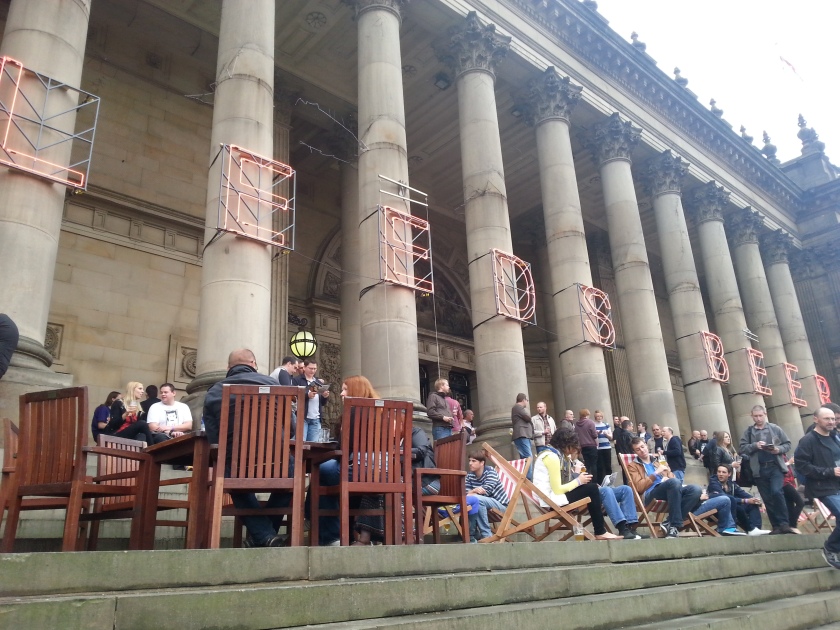
The dramatic entrance to Leeds International Beer Festival, at the Town Hall, Leeds.

My appreciation of good beer began in West Yorkshire.

I went to university in Leeds, and lived in the area for several years afterwards. I arrived there as an alcohol-omnivorous student, drinking Guinness to appear sophisticated, but left with a firm idea of what beer, and good beer, really was. I thought it was something that could be made either locally or far away, but it had to taste proper, and that it had to have something special about it. While I now know the definition of good beer I had as a younger man was vague and nebulous, I occasionally envy his simple understanding. Still, every time I return to Leeds, I’m reminded of great pubs, great beers and great times.

Last weekend, Craig Heap and I returned to Leeds to meet up with friends. It was only a week or so beforehand that I realised Leeds International Beer Festival (LIBF) was on that weekend (honestly). I’d heard good things about the previous two years, and I was curious to see how the Town Hall handled such an event.

It was a fantastic festival. Saturday’s afternoon session was lumbered with damp, drizzly weather, but the outdoor portion (where the street food vendors and disco/beer tent were found) had a music festival atmosphere, while the parts inside the Town Hall reminded me of the better aspects of Craft Beer Rising and London Craft Beer Festival. Friendly staff from the brewers (for the most part) were behind their respective bars, pouring cask and keg beer in great condition from across the UK, US and Europe (Italy and Spain in particular).

It was great to see Ilkley rubbing shoulders with BrewDog, Kernel with newcomers Golden Owl, Magic Rock with Fourpure, Beavertown with Hand Drawn Monkey.  HDM’s Brew #100 was my beer of the festival: a blend of imported Nelson Sauvignon grape must blended with 7% abv DIPA, dry hopped with Nelson Sauvin, refermented and barrel aged in a Sauvignon Blanc barrel. The resulting 11% brew had the electric, crisp and juicy intensity of its two key components in equal amounts, the body of a Greek god but the lightness of touch of a butterfly – a truly stunning technical accomplishment.

London was well represented too, but by no means disproportionately so. It was fantastic to see brewers like Weird Beard bringing some very, very special beers (Ardbeg and Macallan barrel aged versions of Bearded Nurse) and welcoming newcomers to their classics, too. Well, the welcome I got from Gregg Irwin was “You wankers get everywhere!” but I think that was a good thing. Camden Town Brewery brought their classics too, as well as some very tasty rarities, particularly their White Knight (a “barrel-aged Belgian sour”) which was reminiscent of both a tart Berliner weisse and BrewDog’s muscular and woody Everyday Anarchy but at an all-day abv of 4.3%.

It wasn’t all whacky beers, either. There was a healthy representation of handpulls on many bars, with brewers like Marble, Oakham and Kirkstall showing how well-brewed and satisfying cask beers are really done. It was this diversity of intent and execution that really marked LIBF out for me as one of the UK’s best beer festivals. The crowd was happy, friendly and varied: older real-alers wandering over from Mr Foley’s and the Town Hall Tavern to mix with earnest beer geeks seeking the Edge, and lively, facepainted, ‘try-anything’ craft fanciers tasting a lot of beers and styles for the first time. It was that last portion of the demographic that interested me most, and indicates our best hope for all of us continuing to enjoy the great beers like those at LIBF for a long time into the future. Beer festivals need to welcome not just beer geeks, but also people open to the idea of being converted.

Now more than ever, it feels like it was long time ago that CAMRA were providing the best beer festivals in the UK. A very long time ago indeed. Newer, better beer festivals are fighting the good fight in new and better ways, and LIBF is absolutely one of them.

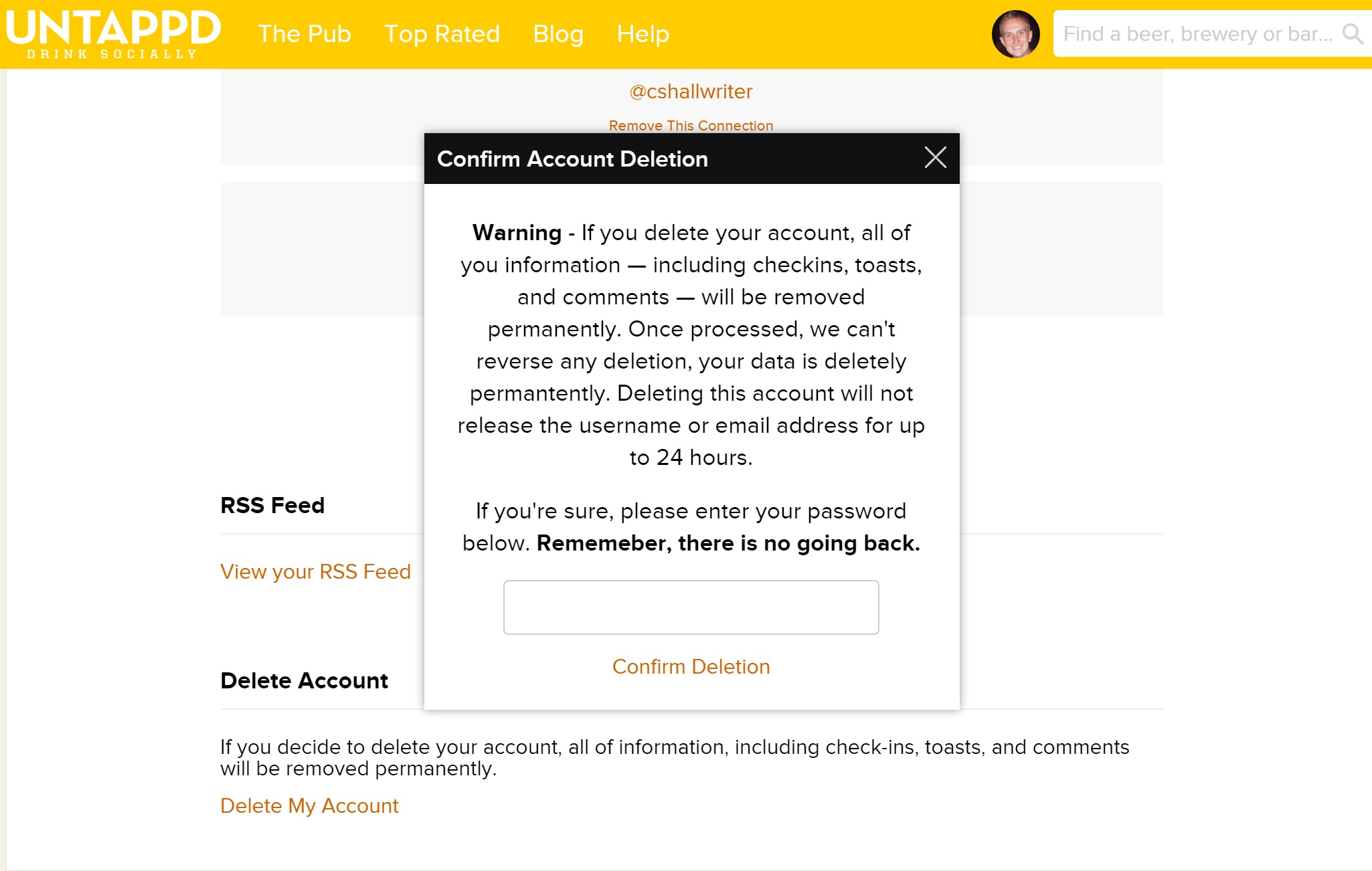
Tapped Out

Tapped Out
(Wow, count the mistakes in that pop up)


This is a blog post about Untappd. If Untappd makes you angry at them young’uns in the pub with their phones and their Pac-Man video games, this blog post may only serve to raise your blood pressure, so you may want to leave.

Since London Beer City started, I haven’t really logged that many beers onto Untappd, and I’ve had a lot of new beers in the past few weeks. Normally the ‘newness’ is the key motivation for me to check something, not necessarily in a ticking instinct, but so that I have some record of when I first tried it, how strong it was or which batch it was for future reference.

Lately, I just don’t have the energy for Untappd. I got into it only a couple of years ago, having seen others use it and enjoy it. The badges, the social network aspect, the toasts, it all seemed fun, and simply anyone who was anyone was using it, so I gave it a go. Like many forms of social media, it’s addictive. Not just because it merges so neatly with one of my main pastimes, but also because it’s so easy. It becomes a ritual. We see each other all reaching for our phones as we return to a table with our new beers. I don’t have any beef with people using Untappd in pubs, nor do I have any problem with social media becoming part of the way that we enjoy and discuss beer. Still, I simply don’t enjoy using Untappd anymore.

There’s no such thing as ‘casual’ Untappd use, or rather, there’s no point to dabbling in it. You either check in every new beer you have, or why bother using it? The idea is to contribute to a global social network of beer lovers sharing and commenting on each other’s beers. I like the social aspect of it, but Twitter already fulfills that function.

Just over a week ago, I saw this tweet from all-round nice guy and lovely beer person, David Bishop:

Now, despite appearances, David is a shrewd chap and has a healthy attitude to beer geekery. That and his other tweets on the subject very much mirrored my own feelings. It provided the necessary prompt in my mind to really think about it again. What do I get from Untappd? I tweet about beer without its help, can share photos of beers I’m enjoying without its help, keep notes about beers I’ve had without its help.

The useful functions: the searchable archive of beers I’ve had for the first time and when; and the ability to see where beers are being enjoyed near me (which has helped me when visiting a new area a couple of times), are just that – useful, but not essential to my experience of beer. If anything, it causes me more annoyance than satisfaction on average. The Android app is clunky, and frequently crashes when uploading photos, despite several updates.

I’m not sure what I want a beer app to be, or even if I want a replacement for Untappd. I’m certain that, once I delete it from my phone, I’ll experience some cravings. I’ll get my fix other ways, through Instagram, making little felt badges to stick on my Craft Sash at home, Twitter, and so on.

I’m also hoping that, as a side effect, instead of logging every new beer with a few choice flavour descriptors, quitting Untappd will encourage me to actually write about the beers worth writing about.

Is Untappd still doing it for you, or is it something that was fun for a few summers and now needs to go in the loft?