Dog Eat Dog World

Copyright Ralph Steadman

Collaborations in the brewing world, especially between microbreweries, have become part of the loving, warm-hearted soul of this industry. It’s a curious thing really, for businesses in the food and beverage industry to collaborate in this way. We might expect it of celebrity chefs, or niche, independent delis and producers, but it hardly occurs elsewhere in food and drink.

In the arts, you can’t move for collaborations between musicians, artists and authors. Sometimes, beer and art cross over. Rapper Professor Green launched his own beer (brewed by Titanic) called Professor Green’s Remedy, and Beck’s have been using artfully-inspired labels created by artists and bands for a few years now. Even Elbow have released a ‘build a rocket boys!’ beer with the helps of Robinsons.

It’s a question that is barely worth asking, really. Why beer? Beer promotes collaboration because it’s one of the great social levellers, the great equaliser between ages, cultures and ideologies that promotes understanding and friendship (although, past a certain point, some people become progressively less understandable and friendly).

Sharing, caring and so on are all very well and good, but how about a little competition to spice things up?

Copyright Johanna Basford

On Monday, I attended the climactic final part of the recent International Arms Race between BrewDog and Flying Dog to create a winning Zero IBU IPA using no hops. It was a fascinating concept, and one that was wisely chosen. After all, instructing two hop-loving breweries to create a superior IPA would simply result in each producing a nuclear-hopped, scorched-earth-bitterness monster, which either could easily do any day of the week. Specifying that no hops could be used levelled the playing field and instead encouraged innovation. After agreeing on a set list of ingredients used to create spicy bitterness instead of hops (including bay leaves, ginger, rosemary and all sorts of herbs and spices), each brewer went off to create very different beers.

I will review each of them properly in a future issue of Rum and Reviews Magazine (once I have received some bottled versions), but the beers couldn’t have been more different, and the event held at BrewDog Camden was a great evening of beery nerdiness. It may have been a ‘Combative Collaboration’ and a competitive one, but both brewers gained from it, and had a lot of fun doing it. The competitive element intrigued me, because we are so used to the likes of Mikkeller simply co-authoring something with every brewery under the sun. Bloggers, writers, anyone can get involved, and that’s great. However, I think the competitive element adds something exciting. It encourages creativity and pushing boundaries, and I think a lot could be done in this regard with food.

Imagine, instead of trying to make the best Beer X, why not try to make the best beer to go with Food X?

The ultimate steak, BBQ or burger beer. The ultimate curry beer. The ultimate dessert beer. A famous chef could define and create the exact dish that the beer must match to, and then brewers could be invited to compete for the accolade of having the best beer to go with it. It’s something that drinkers and bloggers give their opinion on all the time (“for me, if I’m having a curry, I absolutely must have a … to go with it,”) and it would force brewers to put their pride on the line, instead of just idly suggesting an easy food match on the back of the bottle.

What do you think? Are collaborations a Good Thing? Would you like to see more competitions? I’d like to know your thoughts.
"It’s all just a bit of harmless fun."

Melissa Cole wrote a great blog (an open letter, really) a week ago about the use of this sort of thing:
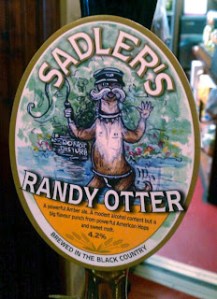
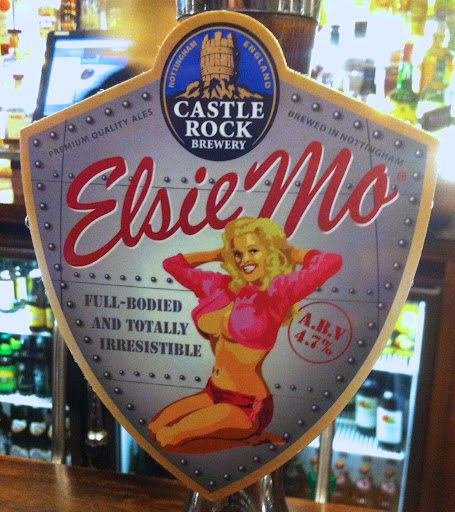
(Images courtesy of the excellent watchdog for dodgy beer marketing Pumpclip Parade)

As this is a real pet hate of mine, I have to add my own feelings on this matter, not a ‘male perspective’ exactly, but hopefully one that is shared by other men.

When I see a one of these beers on the bar, I get angry and embarrassed in equal amounts. I get angry because this is exactly why some people think cask beer is for sad old men. I get embarrassed because, even if I order a completely different ale from the bar, people will think ‘Ah, this chap obviously shares the same sense of humour as the sad, dirty old man that designed the label for that other beer. That’s what cask ale drinkers are like.’
However, when people use the phrase “it’s all just a bit harmless fun”, I don’t get embarrassed. I just get angry. For the sake of argument (and my spleen), let’s put that sentence under the microscope, shall we?
“It’s all just a bit of harmless fun.”
First, it isn’t all just a bit of harmless fun, because not all breweries see fit to market their beer in this way. And amongst those that do, not all of them use the kind of bawdy, seaside-postcard-from-a-time-land-forgot type of humour that we are apparently supposed to celebrate and cherish as part of our innate, cultural backwardness. Some of them, see above, are terrifying glimpses into the psyches of deranged and possibly quite dangerous individuals. The man who drew that Randy Otter one should be sectioned.
Secondly, it isn’t all just a bit of harmless fun, because it extends beyond the pump clips to the grubby, pathetic, middle-aged-boys that think this is ‘funny’, or worse still, sexually arousing. It simply exacerbates a tired old stereotype of a man going to the pub to ‘get away’ from his wife, drink beer, and stare at crudely-drawn pictures of women, otters, figures from folklore, whatever floats their boat.
Thirdly, it is not harmless, because it harms my eyes, my intelligence, and the idea of being ‘a good lad’ or ‘nice bloke’ or ‘gentleman’ that is instilled in most men by their fathers from a young age. If people want to look at pornographic images, that is absolutely fine. If people want to make silly names for things, be my guest. If people want to degrade themselves, the pub, and the beer they are drinking by needing to buy an ale called ‘Top Totty’ and leering at a child’s drawing of a woman in her underwear, they can FFFFUUU-ind themselves somewhere else to do so.
Finally, it is not fun, or at least any kind of measure of fun that I am aware of. This boils down to – and I’m sorry if I’m repeating myself, but it really does seem to be the core issue here – people enjoying looking at crappy, cartoon images of ‘rude things’. If pubs aren’t permitted to sell alcohol to those under the age of 18, they may wish to consider extending this to those whose mental age is below 18 as well.
Let’s all just move on, and embrace the British beer renaissance. Every day people are trying out cask ale and craft beer, and the last thing we want is for someone to think that the guy who designed ‘Rodger the Goblin’ represents the bulk of people who enjoy good beer. 
What really gets to me is how stupid it is, and how it must drive away so many people from trying what may possibly be a good beer. Cynical as I am, I simply assume they are trying to sell off a bad batch of bitter by putting ‘a bit of blue’ on the pump clip. However, I’ve heard that some of these beers are all right. This is even more depressing, because it means they have been effectively reserved for those with the sense of humour of some kind of fist-testicle hybrid.
I am not saying BAN THIS FILTH because, frankly, we shouldn’t need to ban it, should we? We should simply be capable of rising above it. We’re British for heaven’s sake. We should be capable of a bit of class.

Yes We Can


It’s been a hell of a couple of weeks for me, and I imagine, for many of you too. The Olympics of course, plus some outrageously hot weather, the Great British Beer Festival, and all sorts of warm-weather based shenanigans to empty your wallet for. My GBBF coverage will find its way to Rum and Reviews Magazine shortly, but I thought I would share another recent and significant beer experience.
Having finally joined the British Guild of Beer Writers(mainly to further my own ambitions, but also because I have always wanted to be part of a Guild), I was invited to a pre-GBBF event at the marvellous Porterhouse in Covent Garden (reviewed by The Gentleman Drinker here) to try out a wide selection of American craft beer in *DUN DUN DUNNNN* cans. The beer was excellent, and it got me thinking about beer’s relationship with aluminium, and what the future could hold.
The humble can of beer has served us all tirelessly without complaint for decades, and yet, it has a serious image problem. We don’t see the can for what it is, we see it for what it isn’t.
“I said where’s the BEER aisle not the insipid, corporate, industrial…” James Watt  hated going to Tesco.
The 440ml or 500ml can is the default beer SKU in the ever-growing off-trade, and pallets of them dominate aisles of supermarkets across the land. However, despite its ubiquity, or perhaps because of it, people don’t see cans of beer as quality items. There is always a perceived cheapness to them. The industry has come a long way from having tinny-tasting tinnies, but the association somehow lingers on. Bottled beer has perceived class, quality and tradition. Then of course there is bottle-conditioned beer, one of beer’s most important expressions. Secondary fermentation creates fuller flavours, natural carbonation and opens up the wonderful world of aged beer. Even CAMRA will occasionally reach down from Olympus and deign to label bottle-conditioned ale with their logo, designating ‘properness’.
How are cans going to compete with that? In the UK’s current beer renaissance, how can the humble can share space with Kernel, BrewDog and Mikkeller in the hearts of beer geeks? Well, BrewDog have already bought into canning their beer, not in a big way, but both Punk IPA and 77 Lager are available. Surely, I hear you cry, that was just BrewDog doing one of their ‘clever ideas’ wasn’t it? Were we supposed to take them seriously?
Not a joke.
Well, BrewDog were simply emulating the American craft beer scene that they so desperately want to recreate here in the UK. American microbreweries (or rather, what they would call microbreweries) have been pioneering the idea of quality beer in cans for years, and I think it could be the way forward in the UK too.
Why? Well, for one thing there’s the benefits to the brewer. Cans are cheaper, easier to produce, and easier to store and deliver. That could theoretically mean that smaller brewers find it easier to get their beer to more pubs and shops.  
There is also the fact that consumers would enjoy a lower price for their beer, and that it’s easier for them to carry home too. More importantly, they could carry home more of it. As we all know, beer in cans gets colder quicker than beer in glass bottles, and there is absolutely no risk of UV light damage or ‘skunking’. Aluminium cans are arguably easier to recycle, and they are generally more practical and functional than glass bottles. As an example, recall how many times you have had to have sadface-inducing mainstream keg lager in a plastic cup at gigs and festivals because they can’t sell decent bottles of beer? Now imagine being at a gig or festival, strolling up to the bar and seeing some of these beauties:
 As I mentioned earlier, I was lucky enough to sample a selection of canned American craft beer recently, and on the basis of what I tasted, an aluminium-coated future does not frighten me in the least.
I got to taste everything from the big-hitting mainstays like Sierra Nevada to smaller, kookier outfits such as 21stAmendment, Maui Brewing and Caldera. Of course, in American there’s no such thing as small, but these producers give us an idea of how smaller brewers have bought into the idea of canned craft beer, and they’re doing it well.
Something slightly random but important that stuck with me afterwards is that cans have the better ‘opening noise’ than bottles. That sharp percussive crack and hiss flicks a switch in your brain that gets your mouth watering. What’s that about? 
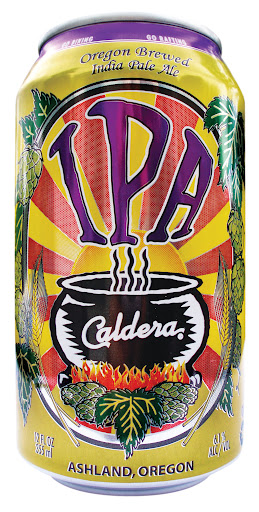
As you can see above, with a change in packaging comes a change in labelling. With cans, the label ismost of the packaging, and most canned US craft beers have really eye-catching labels. There’s garish, gaudy colour schemes that remind you of vintage 60’s music festival posters, star-spangled red-white-and-blue palettes, or stark contrasting colour schemes with stencilled lettering and surreal art. They’re striking, they capture the eccentricity of the beer and its brewers, and most of all, they look good.
  
Sometimes they look a little too good. A few, including Caldera IPA (above) resemble some kind of tropical fruit drink more than a strong beer.
It all comes back to quality. If the quality of the beer can be assured, then eventually beer connoisseurs will be won over. It doesn’t mean an end to bottles by any means. Rather, bottled beer, and bottle-conditioned beer in particular, will become even more special, even more rare and even more desirable. Cans will become the ‘norm’; beer of good quality to be enjoyed without fuss. Bottles will become valued possessions, encouraging more people to age their beer, and encouraging brewers to create beers that are designed to be aged.
Imagine a world where this could be even more amazing than it already is.
Ultimately, true beer nerds connoisseurs will pour the beer into a glass before drinking it, whatever the original vessel. The quality is not an issue – the beer tastes really, really good. The packaging is sharp and exciting, and I think it moves beer away from hefty, masculine pints and big bottles. I think cans make unusual beer like Coconut Porter, Black IPA and the like more accessible and less exclusive.
What do you think? Can you see yourself drinking beers like those above? Is this inevitable, and what place will cask ale and bottle-conditioned beer have in such a future? I’d like to know your thoughts.