Clouds on the horizon, colour in the dark: Interview with Cloudwater Brew Co’s Paul Jones

IMG_20150321_180936

Manchester’s Cloudwater Brew Co has launched this month to a mix of high acclaim and wary suspicion. As much of the UK beer scene, and Manchester in particular, welcomes the brewery’s plans and ambitions with open arms and eager tastebuds, a section of the beer-drinking and industry-critical public has already made its mind up. To them, Cloudwater are a slick, self-consciously ‘craft’ brewery riding a wave of hype and getting a mob of blindly-enthusiastic, instantly loyal fans raving about their beers before they have even been put on sale. This very blog post will be treated by the same people as witless flag-waving by yet another sucker. But there’s more to this new brewery than (admittedly very, very pretty) branding and big talk.

The credentials of those involved, formerly of Marble, Summer Wine, BrewDog, Port Street Beer House, and others, isn’t under any doubt. Early tastings of the first batches brewed on Cloudwater’s kit are almost universally favourable. So what’s so controversial? The brewery’s output and designs for the future are unquestionably at odds with traditional brewing industry. That doesn’t mean an eclectic core range of obscure styles, but in fact, no core range at all. Four separate, distinct ranges will release across each year, using the best available ingredients to make the most flavoursome beers that can be made with what’s available. In an industry increasingly filled with tropes and cliches, many see Cloudwater’s approach as thrilling, while others see yet one more gimmick.

The self-stated focus on “modern, seasonal beer”, deliberately side-stepping the C word entirely, is a simple, pure and impressive attitude. Why say you’re craft, when you just are?. What’s really got people talking though, is the size of the venture. The almost industry-standard approach for a financially solvent and confident new brewery is to start out with a 5 BBL (~800 litres) brewhouse. This is seen as a sizeable, serious but cautious investment. Cloudwater are starting with a brewhouse three times that size, and that’s just the beginning. In Britain, we can’t help but be suspicious and critical of those with deep pockets and high ideas of themselves.

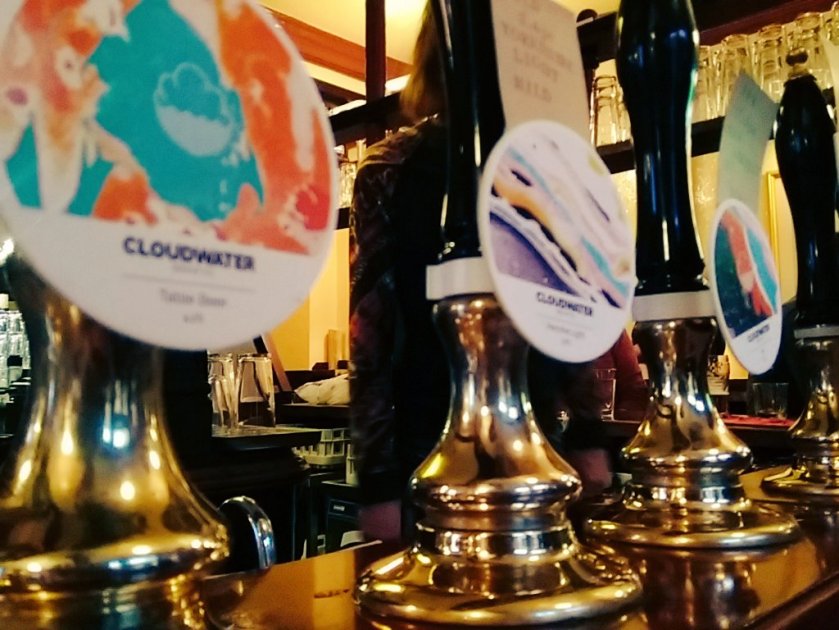
I’ve assured myself of the quality of the beer Cloudwater has made so far (the Pale Ale and Table Beer in particular, on cask at the Wenlock Arms at the weekend, were both beguilingly clever and accomplished). What I really wanted to know was the motivation behind Cloudwater, and how they see themselves and the people who are critical of them. Paul Jones, the brewery’s co-founder, was more than happy to oblige. All the people involved in Cloudwater are heartfelt beer lovers and more importantly, genuine and clear-headed people, but Jones is undoubtedly the brewery’s voice, one that is utterly without doubt and unambiguous about what Cloudwater is.


Why have you started Cloudwater at this size, when many people would see it as safer and less costly to start small first?

“Whilst it’s true to say that a smaller brewery would have probably cost less, only a third of the cost of our set up has been spent on the brewery itself. The rest of our budget was taken up with infrastructure such as flooring, utility supplies, and the equipment and space necessary to package and store our beer well.

“In his previous brewery, James Campbell comfortably brewed on a similarly sized brewery, and built up the brewery to regional, if not national acclaim. If we would have been starting a new brewery, without a head brewer of 20 years experience, it may have been fitting to start small to see how it goes, but James’ track record is strong, and gave us the confidence (some would say cheek!) to be aspirational.

“I’d like to add that we’re not so fresh faced and youthful as we once were. Food and drink industry employees (along with employees in far too many other industries in the UK) are too often woefully underpaid, and consequently result in businesses staffed in the majority by those young enough to not have yet developed significant financial worries or commitments. If we are to be a business responsible for the long-term wellbeing of our founders and staff, we have to take rather less craft-star things like pensions, living wages, retirement plans into account as early as possible. We’re actually trying to run a business as well as a brewery.

“It would have been much safer to not start a brewery at all, but life is short, and it’s important to do what you believe in and have fun too.”


How long did it take you to decide on the size of the brewery you would be building and using?

“We asked many of our friends in the industry for their advice with regards to brew length. The majority suggested we start even bigger (20 and even 30 BBL). If you look at the successes of nearly every brewery that is making great beer right now, you’ll notice many breweries doubling in size in rather short cycles. The resounding opinion was to go for a brewery as big as we could afford.

“What followed was a lengthly process of consultation, investigation, and research as we sought to put as many strong options for our brewhouse on the table as possible.”


Did the beers you want to make determine the brewhouse, space and other factors of the planning, or did the recipe designing come afterward?

“Very early on in planning the brewery we talked about how to ensure we had a modern, technically-proficient brewhouse that would allow us to competently make ales and lagers. This very much informed what we looked for, the manufacturers we ruled out early on, and those who we attracted quotes from.

“Planning a brewery means thinking from as many perspectives as possible about space requirements – How much space is needed for raw ingredients, and packaging equipment and packaged goods? What happens if or when we need to install more fermentors or conditioning tanks?

“We poured over our floor plans as many times as we could, but we had just a rough idea of the space we were looking for. In the end, what it really came down to was the types of warehouses and larger archways that were available, and what we thought we needed to do to transform them into the sort of hygienic food production facility a modern brewery is.

“A significant ambition of ours was always to have an open brewery, somewhere we could welcome the public into regularly. To that end, a brewery in the middle of an out of town industrial estate may not have worked so well for us as a new company, so premises in and very near to the city centre was prioritised. If we can contribute to Manchester’s growing and improving food and drink scene we’ll be very happy.”


A project the size of Cloudwater’s is outside of the financial reach of many breweries when starting up. What would you say to people who think you are ‘buying’ your way to the top of the craft beer scene?

“The first thing I’d say is that life’s a little more fun with a touch less cynicism! There are no shortcuts. The craft beer scene, with the exception of a little hype here and there, functions as a meritocracy. The vast-sized family brewers and global industrial brewers are suffering market share losses despite turnovers that eclipse the craft beer scene in the UK, evidencing the fact that money won’t solve so many problems.

“The only way we’ll get to the top is with a lot of hard, considered, mindful work, as is the case even with those breweries that started out with rather less capital to risk.”


Since you’re starting at a point which many brewers would dream to be in in 5-10 years, does this allow you to dream even bigger for the future, or are you more worried about properly executing everything you plan for the present?

“We’re starting at a point that I believe our head brewer has thoroughly earned and deserves. Before there was a craft beer scene in the UK, even before I really liked beer myself, James was working hard to push the beer scene forwards, and acting as an early (some would say pioneering) champion of NZ hops, and hoppy beer in general. Whilst some brewers may dream of this point in 5-10 years, James has been dreaming of it for nearly 20 years.

“We have a list of ambitions as long as all our arms put together, but we won’t achieve a single one without careful attention to the here and now. A bright future, whilst envisioned by dreams and idealist vision, is the result of current efforts (and a little good fortune and happenstance). We’re starting a new brewery in an incredibly well-developed scene, and would be foolish to do anything other than recognise that quality is ever more important than newness or variation.

“As for worrying about proper execution, we certainly would gain rather more restful nights sleep if it was less of a concern for us, but also, we’re only human (sorry, love that song), and only just getting started. There are going to be people out there, from the cynics, the inverted snobs, right through to the fail-lovers that will cherish any mistakes we make, because of our experience, ambition, jealousy, or for no reason whatsoever. We have never said we won’t make mistakes, or that we’re going to be the best. That simply isn’t in our character at all. But I will say that we are going to work as smart and as hard as we possibly can, with the chief aim of making very enjoyable beer, and to run a business well enough to be around for a long time with which to do so.”
Book Review: Mikkeller’s Book of Beer by Mikkel Borg Bjergso and Pernille Pang

IMAG0218

I have a favourite beer t-shirt (no wait, come back), one I bought from Etsy (no seriously, don’t go). It has a vaguely familiar Californian brewery branding aesthetic and the name of the fictional brewery is ‘OBSCURE – Microbrewery You’ve Never Heard Of’. Anyway, I’m not just bragging about my great t-shirt – looking at it the other day made me realise that there is a new level to the joke. Mikkeller, every part the poster-brewery for experimental and uncompromising brewing oddities, pure beer genius and everything inbetween in modern craft beer, is an obscure brewery that everyone has heard of. Production, even when including the many projects all over the world, is relatively low in total, yet the reach is wide, the legacy large and the shadow long. This is the modern brewery, so what, then, is the modern brewery book?

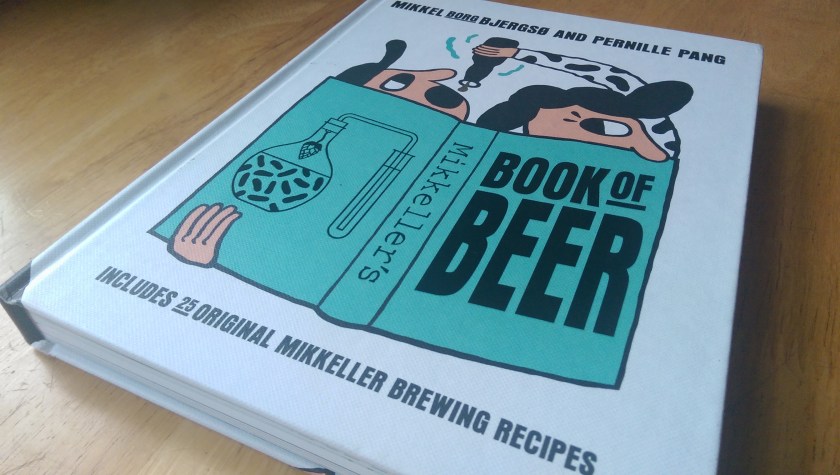
Just as every beer and brewery has a story to tell, so too do the brewers. That compulsion to write their own history, and that of beer too, has motivated a number of American brewers to pen their own bestselling beer books, and we’re now seeing the trend continue here in Europe. Highly anticipated in the craft beer community, Mikkeller’s Book of Beer is co-written by brewery co-founder Mikkel Borg Bjergso and professional journalist Pernille Pang, who is also Bjergso’s wife.

The first chapters of the book feel personal, and the desire to tell his own story in the book’s clipped translated English (familiar to readers of English versions of Scandinavian fiction) makes for a quick and absorbing read. As with anything of this nature, the reader is wary of the authors editing history to suit their narrative, and there is a perhaps controversial recurring habit of measuring Mikkeller’s success by Ratebeer scores alone. Still, it gives a fascinating insight into the mind of a determined and resourceful man across the book’s clean and crisply-laid-out pages.

Of course, much of his story is well-known, and the book proper begins with a potted version of beer history that concentrates on the fun stuff (and, notably, CAMRA), and a breezy trip through major beer styles. The first major problems arise here: for the experienced beer buff, the reliance on heavily debunked myths of style origins may come as shocking, and the IPA section alone might be enough for some people to give up on the book entirely. Meanwhile, the newcomer may find the short, breathless descriptions to lack depth or imagery to capture the imagination, but then, that’s what all the beautiful photography is for. There are also some clumsy paragraphs and phrases that feel like they’ve been wrung through Google Translate, but generally the book maintains an easy-reading pace throughout.

IMAG0214

The book’s real appeal to existing beer nerds lies in the selection of 25 recipes for Mikkeller beers and 5 recipes for other brewers’ beers. Whilst laying bare the recipes for I Beat yoU, Beer Geek Bacon and Texas Ranger shows an impressive amount of transparency on Bjergso’s part, I suspect most will be even more impressed by the inclusion of recipes for Firestone Walker Wookey Jack, To Ol Goliat and Kernel Imperial Brown Stout.

The guide to starting homebrewing itself is packed with handy tips, but also comes a cropper from the occasional confusing sentence or questionable translation, which, when on the topic of oxygen in the brewing process for example, is pretty worrying. The whole thing feels useful in conjunction with other more trusted books on the subject (How to Brew by John Palmer, for example) but not a true foolproof brewing bible on its own.

Where the language and tone of the first half of the book is aimed at the beginner, the food section fells far more advanced in some ways. However, it does overcomplicate some of beer and food matching’s basic principles, recommending only sweet beers for cheese for example, yet a variety of beers for different kinds of shellfish, which is perhaps more of an indication of its Scandinavian origin than knowledge gaps.

The food recipes included, meanwhile, are almost exclusively high-end, Masterchef-esque constructions of the most expensive ingredients using the most obscure methods. It’s hard to see anyone who is actually capable of these culinary feats relying on such a text as their guide, but it certainly all looks very nice, and that might be both the book’s biggest strength and its main weakness. The gorgeous design and pleasingly simple artwork from Mikkeller label designer Keith Shore makes for an easy read, but not necessarily an engaging one.

Whilst it is pretty to look at, and will provide a valuable source for homebrewers (as just that, a source, not a bible), this is by no means the ‘Ultimate Guide for Beer Lovers’. With its artistically impressive layout, repeated reliance on debunked myths but tempting recipes and insight into the rock-star brewer’s rise to fame, this is perhaps then the beer book that the craft beer generation deserves, but not the one it needs. Mikkeller’s book is a beautiful one, but requires the context of more grounded works. Mosher, Palmer et al have little to fear.

Recipe: Beer, Bacon and Parmesan Risotto

IMG_20150317_221504

After a cursory query on Twitter, I got a lot of great suggestions about potential beers to use in place of wine in a risotto. In the end I decided get a bottle of Orval with a few months on it, hoping to get the sharper, funkier flavours without too much bitterness. Unfortunately my regular stockist was out of Orval, so instead I went with a slightly more left field option suggested: a smoked dark wheat beer, in this case the brilliant Freimann’s Dunkelweiss by Hackney’s Pressure Drop Brewing. Check out the Twitter thread in the link above to see other suggestions. Popular choices included saisons, sours and amber ales.

Essentially, you’re using beer in place of wine in the risotto-making process, but you also need less stock as your beer is helping to act as that too. Pick a beer that – alcohol and carbonation aside – has flavours you would like in a sticky, comforting risotto. My recipe has bacon in it because bacon is amazing, but you could just use more mushrooms instead if you want. Also, I really wanted to put the smoky flavour of Freimann’s in the mix with some smoked, streaky bacon. Ingredients and method below.

IMG_20150318_220759

Ingredients:

The below makes a portion for 1 person, so scale up as you wish:

  • 100g Arborio (risotto) rice
  • 2 rashers smoked streaky bacon, chopped
  • 1/2 an onion, chopped
  • 1 garlic clove, finely chopped
  • 2 mushrooms (optional), thinly sliced
  • 1 tbsp butter
  • 15g Parmesan, grated
  • 125ml beer (in this case Freimann’s Dunkelweiss)
  • 125ml chicken stock
  • Salt and pepper
  • Parsley, finely chopped, to serve

Cooking time: 40-45 minutes


Method:

1. Melt the butter in a large, heavy frying pan and gently fry the onion and garlic for a few minutes. Once softened, season with a little salt and pepper. I’ll be honest with you, I’m fairly free with butter in cooking, I daresay, like many people, I used what looked to be ‘enough’ to gently fry the onion.

2. Add your rice, stirring as you do and coating it all with the butter, onion and garlic. Fry this for about 3-5 minutes on a medium heat until the rice starts to go translucent.

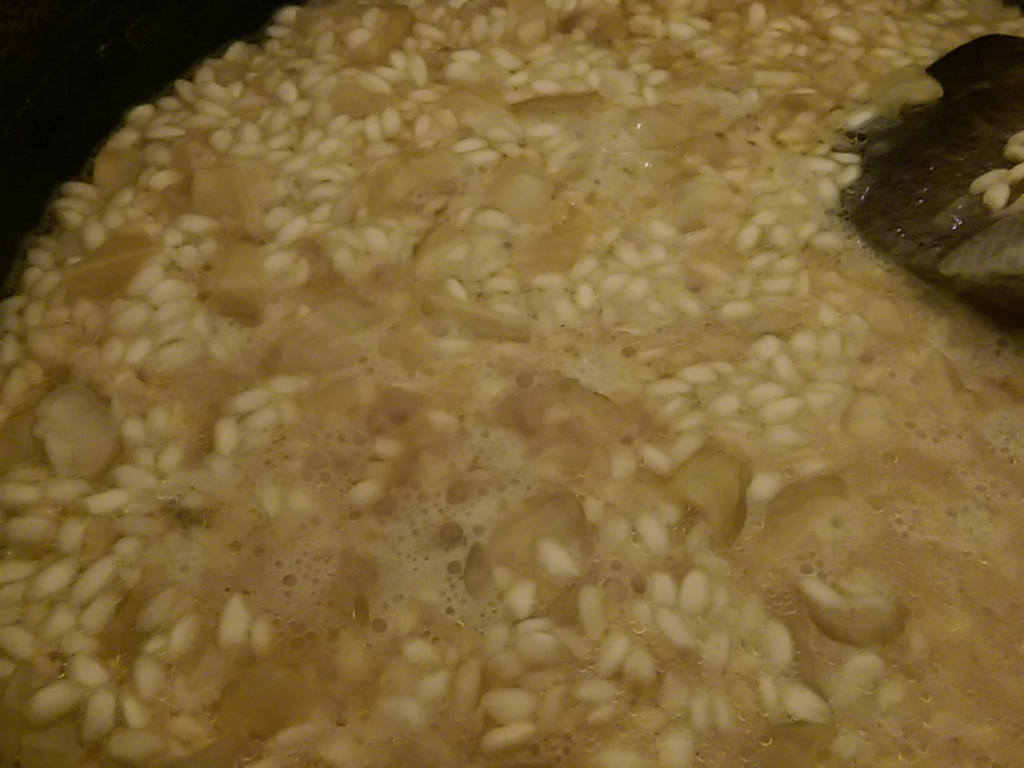
3. Now it’s time to add the beer, but do so gradually, as if you were swigging mouthfuls from the bottle (hey stop! Well, ok, maybe a little) Add a bit of beer, stir and let the rice absorb it, and then some more, and so on. If you’re using a smoked beer, this amazing toasty, fruity aroma should be filling your kitchen. Keep the pan on a medium heat. The alcohol will boil off and all the sticky goodness will be left behind. The rice will take on a slightly darker colour now, depending on the beer it has absorbed.

IMG_20150317_201416

4. Next, do the same thing again but with your stock (no swigging!) with just a splash at a time, stirring and allowing the rice to absorb it. The grains should gradually fatten up and the liquid thicken. Again, just a medium heat is enough. The beer and stock adding part of the process can take up to half an hour. It pays to be patient and steady. When about half of your stock is left, get a small non-stick pan with your bacon and mushrooms going on a medium-to-high heat. Add a splash of oil if you want, but if it’s streaky bacon you probably won’t need to.

5. Take care to keep an eye on your bacon and mushrooms, stirring them occasionally between adding stock to the risotto. When all your stock is used up and the risotto has absorbed almost all its liquid, take the pan off the heat and stir in your parmesan. After that, add your bacon (crispy, not crunchy) and mushrooms. Give it all a big stir and serve into bowls with parsley sprinkled on top.

IMG_20150318_220042

Beer match:

Whilst the full-on smoky fruitiness of Freimann’s was perfect to use in the dish, I wanted something slightly less intense but still smoky and flavoursome to serve alongside it. I’ve recently fallen in love again with Anspach & Hobday’s Smoked Brown, which was a perfect match and would even make a good candidate for a beer to use in the recipe. The beer is fairly sweet with a rounded, oily bitterness and a clever, deep and smooth smokiness that brought the dish to life, and had the body and carbonation to cut through the fattiness and enhance the rich flavours. Lovely comforting nourishment all round.

If you’ve done a risotto with beer as an ingredient, share your successes in the comments below. I’m really keen to try this again with some different beers, and if you’re patient it’s a really easy and tasty dish to make. Cheers!

Rediscovering Anspach and Hobday

IMG_20150312_205248

In the past year, the Bermondsey Beer Mile has quickly and perhaps undeservedly became one of the country’s foremost beer ‘things’. From early on, there was a sense that this self-made beer blowout stretched across a handful of breweries in southeast London couldn’t quite sustain itself. The queues, the walking (or artistic usage of multiple Uber discount codes) and occasionally sub-par beer put many people off after a few tries. But then, don’t all ‘legendary’ pub crawls suffer from the same problems?

Some problems were more specific. One major casualty from my own mixed experiences of the Beer Mile was my enjoyment of beer from Anspach & Hobday. Despite enjoying their beer in bottles and whenever I saw it at a Craft Beer Co pub, I had on more than one occasion tasted beer from the brewery that lacked finesse, and on one occasion, patience. Back then, I worried that the brewery was engaging in a demanding weekly event beyond its grasp, and not always being able to provide beer in the best condition it could be.

Last week, Justin Mason and I were invited by Bottle & Bean to take part in its first live beer tasting video for its subscribers, which featured the first monthly resident brewery, none other than Anspach & Hobday. Part of me was looking forward to seeing what Paul and Jack had been making since I’d last visited the brewery, but I retained a little hesitation from my past disappointment. From the first sip of beer I tasted, I was reassured. I ate my words, or rather, drank them.

With each beer I tried, from their oldest and most practiced like the Smoked Brown and Table Porter, to newer recipes like the Stout Porter and Pale Ale, I was deeply and fully impressed. The Pale Ale was, to use an adjective I find myself using more frequently and tellingly, ‘Kernel good’, its light and faintly biscuity malt body a simple and well-built stage for a floral and rounded hop character that delivered juicy lime and kiwi flavours cleanly. It is undoubtedly a Juicy Banger.

The Smoked Brown, always A&H’s most unique and trusted beer, has improved further still, and is easily one of London’s, and the UK’s, most accomplished malt-forward ales. The smoky character is delicate but persistent in every drop, adding depth and dimension to a rounded, mouth-coating caramel body and a simple yet resinous hoppy bitterness. I was surprised to learn from Paul that the Smoked Brown requires more hops in the boil than any other beer they make, but the balance that this achieves is genuinely fantastic.

Both the Table Porter and Stout Porter showed the brewery’s key strengths in different ways – the Table version demonstrating an ability to extract the absolute utmost of flavour, whilst the Stout variety showed a real skill in nailing the balance necessary to make great strong beers truly great.

IMAG0187

These technically accomplished core beers aside, it was the samples of other more limited beers served at the brewery taproom that made me eager to return. A sour ale, in truth the ‘control version’ of a beer due to be completed in a number of different ways, was made with a sour mash instead of inoculating the beer in its fermentation stage (to reduce the risk of infecting other batches) and on its own had the vibrant, sharp and uncompromising sour bite I love. The limited edition White Coffee Milk Stout, a deep burnished golden colour and ripe with vanilla and coconut aromas, was just a tart citrus ingredient away from being a creamy, whipped syllabub cocktail. The oily sweetness and lactose-rich body wasn’t entirely my sort of thing, perhaps best enjoyed by those with a sweet tooth, but damn good nonetheless.

The final beer we tried made me chuckle with delight just from smelling it, a Galaxy Saison conceived by Dylan, a newer member of the brewing team. The glorious peach and papaya aroma had a crackle of black pepper running through it. The flavour developed from sweet, sugary guava and watermelon into a fascinating mid-palate note of strawberries covered in black pepper, ending with a spicy astrigency. The ABV was fairly restrained (for a modern saison) at 5.2%, but provided all the oomph the beer needed. The flavours were blinding.

You might not need any persuading that Anspach & Hobday are making great beers, but if you do need persuading, please do take my word for it. Maybe though, like me, you have a had a different bad experience with a beer that has affected, consciously or unconsciously, your willingness to try beers from that brewer again. As simple and as basic a lesson it might be, it remains one worth re-learning. If people deserve a second chance, then undoubtedly so do beers.