New Dog, Old Tricks

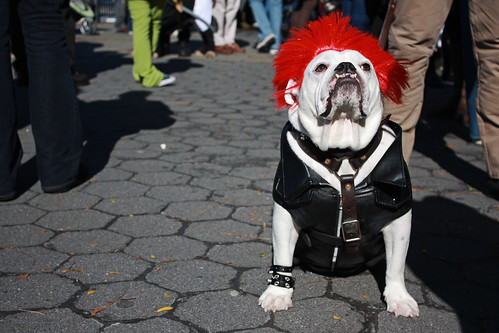
(‘black white red all over’ by istolethetv, from Flickr, under Creative Commons)


I know, I know. Writing about BrewDog is so 2009, but then, so is what’s been happening between the brewer and the Portman Group this week. I also know that this is how the BrewDog PR model works – people writing about them, so they don’t have to – but there’s something important to be said here. In this latest spat, Portman took a deep – and from its own point of view entirely justified – disliking to the ‘live fast’ language on Dead Pony Club’s label.

BrewDog’s response was much in line with what we’ve seen years ago. The sinking of eager teeth into that always-exposed juicy flank of the drinks industry: its clumsy and flabby self-regulatory body the Portman Group. Portman totally had it coming, and deserved every spit-laced snarl, but it all felt very familiar, didn’t it? The reaction online was very much ‘same-old, same-old’, but I was concerned by just how ‘retro’ this seemed.

Lately, we’ve seen signs of what could be called ‘phase 2’ of BrewDog, which began with the opening of the more subdued, mature and less branding-heavy bar in Shepherd’s Bush (now easily their most celebrated in London). Was this a one-off, we wondered, or the start of something new? The appearance of the newly-opened BrewDog Sheffield and refurbished beer board of BrewDog Shoreditch suggested that this was The New Way, and indicated, along with some more thoughtful and artistic recent beer releases, access to Cicerone training for staff and shareholders, and a very gradual attitude shift, that we might be seeing a transformation into a newer, maturer BrewDog.

No longer would they need to shout, point and make an exhibition of themselves to get column inches, demand they can’t supply, or popularity beyond their grasp. People come to BrewDog now, not the other way round, thanks in part to the growing international chain of bars. The company (which, I note, is not a term ascribed to many other breweries, perhaps because so few of the newer wave have such a firmly-established estate) is a definitive peak on the UK’s craft beer landscape that we can all point to and say ‘things are different now, look at that‘. So why set this transformation back for the sake of a few (albeit deserved) laughs at the Portman Group?

Based on the subject of recent surveys sent by email to shareholders and BrewDog website users, there have been hints that the brewer’s branding itself is potentially subject to change. Some questions asked what the labels seemed to imply about the company and the beer in the bottle. My own view is that the branding is well overdue an upgrade to keep up with the best of UK’s scene (and why they haven’t asked Johanna Basford to design all of their labels is beyond me). Perhaps, in keeping with the forward-looking ‘phase 2’, a rebrand is on the horizon that would result in labels that wouldn’t have raised the hackles of the Portman Group in the first place.

After all, that label copy is from a couple of years ago, and it seems that BrewDog’s response to the Portman Group’s ruling came from a similar time period. I wonder if, had the Portman Group left it a few months, there wouldn’t even be a label to complain about. As it stands, it feels like we’ve just done a bit of time travel, with no discernible benefits for anyone. BrewDog came under attack for something quite old and responded with the only weapon at their disposal, one just as dated.

As a shareholder, I’m looking forward to seeing more of ‘phase 2’ BrewDog at this year’s AGM, and I hope this week has just been a blip on an otherwise promising progression to something better.
Traditionally Modern

2014-04-24 18.45.40
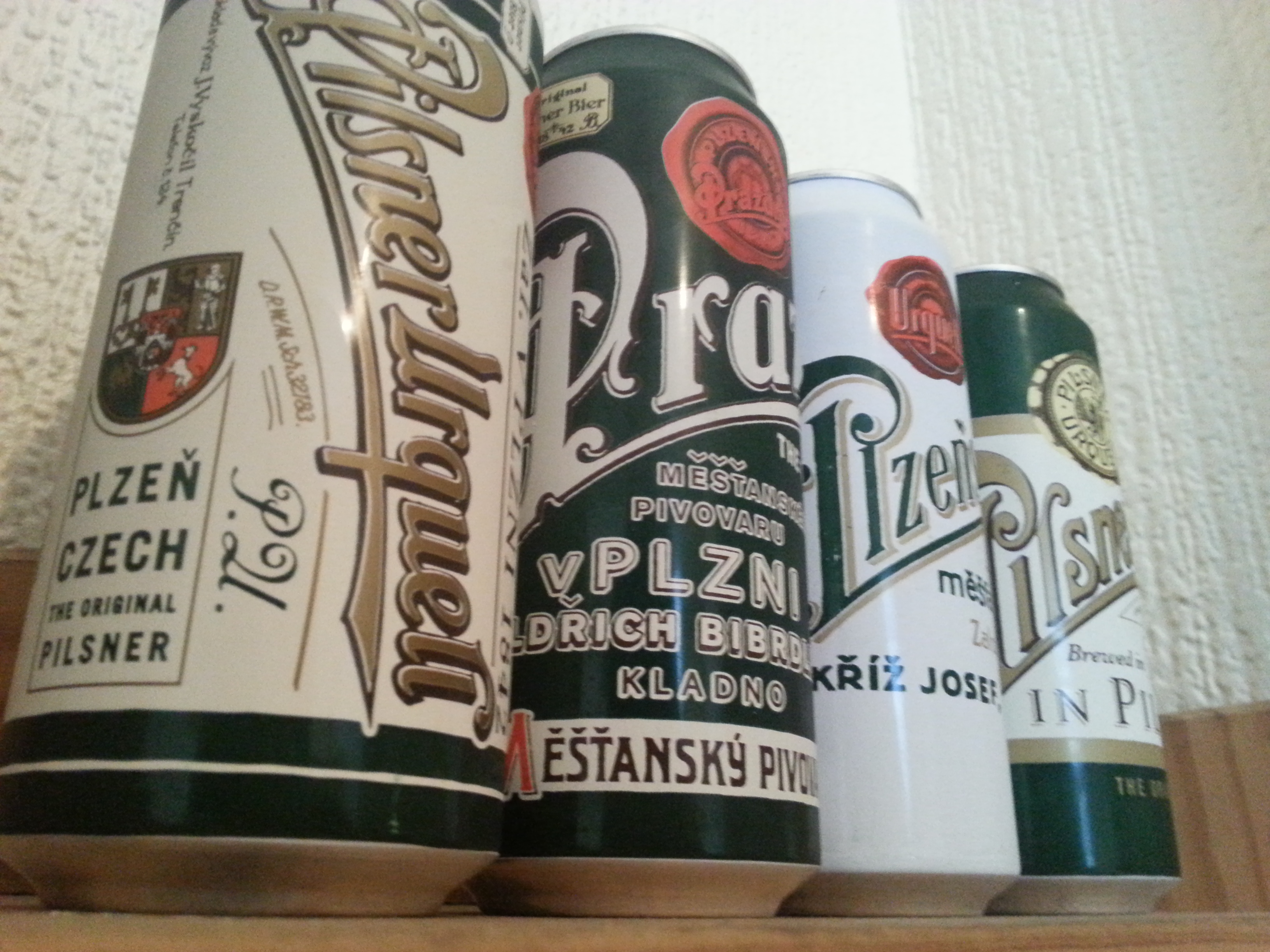
The new Pilsner Urquell cans coming soon to the UK


Breweries with an illustrious heritage often struggle to shake off the fusty, traditional image that grates with modern artistic design. In an effort to stay modern and relevant, any attempt  at a violent rebrand is usually clumsy, and often ends up sacrificing what people liked about the brewery’s image in the first place. It’s refreshing then, to see the beautiful labels of the new canned version of Pilsner Urquell that should be arriving on these shores in the next couple of months.

As you can see from the image above, these aren’t just any labels. In a nod to the brewer’s rich history, Urquell are selling their new cans in four packs, with each can bearing a different, limited edition label, based on four different designs from the brewery’s archives (my favourites are the two on the left). It’s slightly reminiscent of the arty labels that Becks had commissioned a while back, yet in Pilsner’s case I think this really keeps true to the brewery’s history and branding without pandering to fashion.

They look really, really good, especially in the rather *craft* cardboard sleeve, and the beer inside tastes on a par with draught Pilsner Urquell in terms of freshness and mouthfeel. They should be hitting shelves in the UK in time for summer.

2014-04-24 18.43.17

In more Pilsner packaging news, Urquell will be selling bottled Pilsner entirely in brown glass in the very near future (EDIT: likely to arrive in the UK next year), and there are plans for more of their Tankovna (brewery-fresh, unpasteurised pilsner tanks) to be installed in pubs both inside and outside of London. I’ll be discussing the Tankovna version of Pilsner in a future blogpost, but rest assured, it’s damn good stuff. Like the freshest pilsner you’ve ever tasted, with the smooth, quaffable mouthfeel of cask ale.

The brewery has also sent some wooden casks of the unfiltered version of Pilsner (enjoyed by the attendees to EBBC13 last year) to several pubs around London this week. There’s info about where you can find some today or tomorrow on this page of their website (has an age checking thing).

Thanks to Mark Dredge for getting me an advance four-pack of these cans. Yet more evidence, if more evidence were needed, that 2014 will see the Summer of Cans.

2014-04-24 18.45.14

100 Best Breweries Bonus Content: Interview with Camden Town Brewery’s Alex Troncoso


Alex Troncoso at the Camden Town Brewery Bar


Our new issue of Craft Beer –  ‘The 100 Best Breweries in The World’ was such a huge piece of work that not everything fitted into the pages of the finished magazine. A few bits and pieces of interesting stuff were regrettably cut for space, so in the interest of completeness, and to give you a taster of the content in the magazine, I’ll be posting some ‘bonus content’ here for the good men and women who read this blog.

First up is an interview with Camden Town Brewery’s Head Brewer and all-round top bloke, Alex Troncoso:


Alex Troncoso joined Camden Town Brewery at the start of 2013, having previously worked at Little Creatures in Australia, where he was Chief Brewer and Head of Brewing Development.


What does brewing mean to you?

There’s a quote from a homebrewing book that I really like: “Art meets Science and has a beer”. I like that it’s highly technical but also creative. It’s greater than the sum of its parts, you know? You can calculate colour, you can calculate bitterness, analyse those and think that’s probably about right. Roughly estimate what you attenuation is going to be, your level of alcohol, but you can’t calculate flavour or exactly what it’s going to be. I like the fact it’s technical, there’s a lot of history, and it still involves artistry in some ways.


Who inspires you as a brewer?

What I like to say is that companies that are grounded, who have a strong commitment to what they’re doing, big ones like Sierra Nevada who are still a fantastic brewery, we can all aspire to be like them. The kind of guys who have been in a brewing company, and made it to a certain level of capacity, they run everything like a military operation, they can control quality, efficiency all that sort of thing. Using all the technology in the world, not to make things cheaply but to make things better.

So that’s what I like about what we do here. It’s very hands-on and we’re very small here. What we’re doing is using a lot of technology to take out some of the less important work so we can focus on the more important work.

IMG_20130309_172105

How would you describe Camden’s beers to someone who has never had them before?

In my previous life, I worked for another brewery called Little Creatures. Their Pale Ale was at the time, like crazy bitter, but now it’s like normal bitterness – 42 IBUs or something – but at the time I started it was insane.

Regardless of the bitterness level, we always strived to have a certain balance to everything we made, and that’s what I’m trying to do at Camden. Anything we make, even if it’s a bit bigger, like Camden Versus Odell, or the Camden Versus Italy Märzen, even with things like that we try to keep the balance.

At Little Creatures I was used to making bottle-conditioned pale ale, lots of it, so that was a lot of fun but it was also quite complicated. The process of something like Camden Hells is simpler, but in a lot of ways it’s more difficult to make, because there’s nowhere to hide any mistakes! With Hells, it’s very easy for it to be too bitter, or too sweet, and every single beer has its own sweet spot to it.

It’s just a matter of dialling it in and figuring out where it is, but also remembering that the sweet spot might change from year to year. At times, say like this year, Pale at the moment is about 42 IBU, next year we could push it to 45, or maybe it has to be 38, and that can be dictated by the hop crop that year [and what we have to work with].

So anyway, balance. You got to remember, you’re not going to appeal to everyone, but I just want to put something on the bar that looks great, smells great and tastes great.

IMG_20130517_152647

Which of your beers do you feel is your greatest achievement?

From our one-off beers, I think Camden Versus Odell. It’s bloody brilliant! It was all pretty casual, we spoke to Doug Odell, we’d talked about what we should do, we originally wanted to do a lager, but we had kind of already done a highly hopped lager, with SKA Brewing. They suggested using Cutthroat Porter as the base for a beer, I went back and said ok, but let’s do it as a Baltic Porter, make it a bit stronger. Scaled everything up but used in the same proportions. That was really fun.


And the most difficult?

The one that had me on the edge of my seat was Camden Versus Italy: the Märzen (a German lager beer style traditionally brewed in March and matured over the summer). When we brewed it, it looked great, colour was bang on, bitterness level was bang on. But when I started tasting at the start of the maturation period, it wasn’t right. It tasted bitter as hell, looked like swamp water and I thought “Oh my God!”

We brewed the beer with three different Italian brewers, so they’d each be asking me “How’s the beer coming along?” and I’m thinking “Oh shit.” It got to the point where I thought we would have to dump it. I was really, really nervous. I kept saying to myself “Don’t panic! Give it time,” like every day, checking it. And over time, the flavours gradually came together, getting slightly better every day, until after the three weeks of maturation after fermentation, it just kind zoned in to where it needed to be. Then it ended up tasting fantastic!

I spoke to this German brewer about it, explaining how I was really panicking about it, and he just  said “ah, the Marzen takes time,” and I was like “ah, okay.” But it was great for everyone on the team to see how a beer can change and get better, and it reinforced that, with the lager beers especially, we need to give them time.


IMG_20140411_194213

Since the brewery bar opened, Camden has always had a really strong connection to local street food vendors. Do you have a favourite beer and food match?

Yeah, man: Motherflipper burgers! They’re here tonight and I’ll definitely be having one of those later. I’ll probably slam one of those with a pint of Unfiltered Hells.


Are there any special beers planned for 2014?

We have lots of ideas, so we worry more about how we’re going to be able to do them all! To try and get anything special fitted in, we need to plan quite far ahead, at least 3 months in advance because the tank schedule is just so full. We have about 5 ‘Versus’ collaboration beers in the schedule now and a few other little things, too.


You can read more interviews with the world’s top brewers in ‘Craft Beer: 100 Best Breweries in The World’, now available in newsagents and online.

Craft Beer: 100 Best Breweries in The World


Available in WHSmith, supermarkets and newsagents.

A new guide to the best breweries in the world and the stories behind them and their beers.

This week you should be able to get your hands on the second issue of Future’s ‘Craft Beer’ bookazine series: the 100 Best Breweries in The World. Like the last issue, Craig Heap and myself were asked to create and write it, this time with the additional help of a Few Good Men (Matthew Curtis, Ruari O’Toole and Leigh Linley). Copies should be hitting the shelves of WHSmith, larger supermarkets with magazine sections and decent newsagents right now. You can expect:


– In-depth features on 100 breweries from the UK, US, Belgium, Germany, the Czech Republic, Italy, Ireland, Scandinavia, Australasia and more!

– Tasting notes for beers from each of the breweries

– Interviews with head brewers and the stories behind their beers

– Guides to the best pubs, bars, beer festivals and beer culture in the UK, US, Belgium, Germany and the Czech Republic

– Features on the brewing process and brewing equipment, brewing history, abandoned breweries, and some general beer appreciation and consumer-focused helpful info.


If the first issue of ‘Craft Beer’the 365 Best Beers in the World – was a mixtape of the best of the modern beer scene, this second issue is something slightly more thoughtful and complex. Perhaps a ‘background to cooking breakfast’ Radio 4 program about a particular genre of music, exploring the inspirations, variety and depth of the scene.

When Craig and I were asked to write a follow-up to the 365 Best Beers in the World, covering the world’s best breweries seemed like a good next step. The content was always going to be far more than just a list, and as we fed more and more ideas into the outline, it became quite clear we would need some reinforcements.

Leigh Linley, Matthew Curtis and Ruari O’Toole are great writers and good friends of ours. Craig and I were both certain that they had the determination and boundless enthusiasm to get the job done. By dividing our labours, we could each add our own expertise and passions to different areas of the project. Splitting the UK breweries between the five of us, Craig, Matt, Ruari and myself each took on one of the other major brewing countries (I chose Belgium, Craig takes on the Czech Republic, Ruari covers Germany and Matt covers the US) and a couple of features each.

Another key decision early on was to try to get as many in-depth interviews with brewers as we could. Our interviews show that, like the breweries themselves and the beers they make, brewers simply do not fall into one particular category or type of person. At the European Beer Bloggers Conference last year, Garret Oliver said in his keynote speech that ‘Beer is People’, and I think this is a good introductory idea to what the new magazine is all about. At the heart of this amazing industry are some amazing people, and this magazine tells the story of some of the best of them.

I hope people enjoy the new issue as much as the last one. I can’t wait to read it myself. I worked with some fantastic writers on this magazine and I’m really looking forward to reading their work. Cheers!

‘ Craft Beer: 100 Best Breweries in the World’ is available to order online, and should be on the shelves of a WHSmith, supermarket or newsagents near you. I’ll add a link to this post for the iTunes version shortly (and subscribers to the last magazine through iTunes may already have early access).