Electric Citrus: the rise of the Juicy Banger


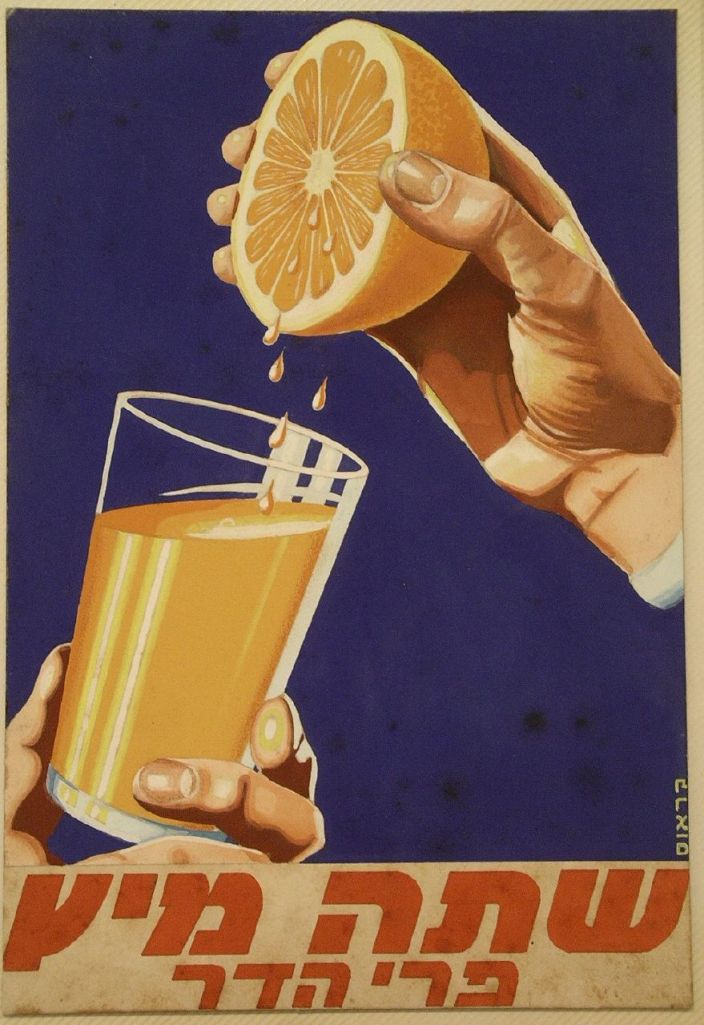
'Drink citrus fruit juice' by David Lisbona, from Flickr, under Creative Commons.
‘Drink citrus fruit juice’ by David Lisbona, from Flickr, under Creative Commons.


The more of them I drink, the more I realise they have something in common. Whether ale or lager, 3% or 6%, a loose new category of beer is beginning to form from the current new wave. It’s a less of a style and more of a statement of intent, and a demonstration of skill that will come to define the current crop of craft brewers in the UK.


In London we are blessed with a high number of breweries, true enough, but it’s the sheer number of beers available that really blows me away. As I’ve said before, the city seems to thirst for the most esoteric and newest things it can find, and it’s no different with beer. Lately though, it hasn’t been the barrel-aged saisons, imperial stouts or even the increasingly impressive range of quality lagers and finely-tuned sours being made in London that have impressed me the most.

A label I apply frequently when referring to juicily fruity, tartly bitter IPAs and pale ales is ‘Juicy Banger’. It’s been pointed out to me that it sounds like something unsavoury said on The Only Way is Essex, but I continue to use it nonetheless. It captures in two words everything I look for from my first beer of the night: a full-bodied but brightly refreshing, finely-balanced beer of big flavour yet peerless drinkability. It’s become a hallmark by which I measure a brewer. If they can brew a Juicy Banger, a beer loaded with assertive, juicy hop character but one I could happily drink all night, and by the pint, then they’re all right by me.

Beavertown’s Gamma Ray and Pressure Drop’s Pale Fire, arguably leading the field of Juicy Bangers in the capital, each have tribe-like followings. The joy with those beers, Pale Fire in particular, is trying it every time you see it, and detecting the growing ability and confidence of the brewers as they dial it in ever tighter and tighter. Gamma Ray went through a similar period of improvement, and now, as those immediately iconic cans roll out of a bigger, better brewery in Tottenham Hale, it has reached its zenith. This is key: we aren’t just brewing more beer styles, we’re brewing better beers.

It’s now got to the point where I think of Juicy Banger as a style in its own right. Perhaps as recently as a year ago, I would have simply thought of them as pale ales and IPAs, but not anymore. Not since Camden Town Brewery’s Indian Summer Lager, and its genetic successor IHL (Indian Hells Lager). Each have their roots in the same brewery’s USA Hells, but it’s those two newer beers that have for me redefined what kind of beers we can make in the UK. These aren’t just hoppy beers, they are astonishingly balanced lagers delivering the hop hit of the most accomplished IPAs. I had the pleasure of trying a few cans of IHL at a recent canned beer competition in London, ahead of its official launch in a few weeks’ time. It is hugely impressive, not only in terms of its High Definition, bright, electric citrus flavours but also its finely balanced body. It might be the best beer made in London.

More generally, it would appear that the trend for brewing the palest possible ales to showcase hops (arguably started by Thornbridge with Jaipur and Kipling, correct me if you know different, and I don’t mean ‘golden ales’) has reached a sort of logical extreme, or another, further branch on the evolutionary tree: these pale ales have become lagers. This decade’s definitive beer style, the one that we will be able to identify with certainty in 5 or 10 years time, will not be an IPA or a saison, but a pale-as-sunlight, hop-forward beer that demonstrates true brewing skill, whilst remaining accessible enough to recruit new fans of craft beer and be sunk by the pint in bars across the UK.

For the time being, this field is populated almost entirely by American Pale Ales and IPAs, but I predict others will take up the challenge implicitly laid down by Camden Town and pitch their own spin on IPA/pale ale/lager hybrids.  Several already exist: Weird Beard Citra Pilsner, Williams Bros Caesar Augustus and Adnams Jack Brand Dry Hopped lager just off the top of my head. Even Fuller’s have had a go at it in the form of Frontier. Plus, as if to prove the lines between ale and lager blurring even further, Beavertown and Camden recently brewed a collaboration lager combining the body of Camden Hells and the hopping of Gamma Ray: One Hells of A Beaver. It, needless to say, is a Juicy Banger, but astonishes me mostly because it marries the body of Hells and the hop character of Gamma Ray seamlessly. So if whether it’s an ale or a lager doesn’t really matter, how then, by current criteria, does one know a Juicy Banger? Here are some recurring factors:

Fresh – Freshness is important now more than ever before, as an increasingly connected world becomes less tolerant of delay and any potential inhibitor of flavour. As the newer craft brewers expand, it might also be that to improve freshness they sell this beer in a:

Can – It’s not perfect, or the messiah of craft beer, but the can has a lot going for it, not least the tendency to feature stunning designs that open people’s eyes to what beer can be. Whilst it’s not essential to be canned to be a Juicy Banger, it doesn’t hurt. They #can also be very good value, especially if they are sold:

Local – A criterion hand-in-hand with (but not the same as) freshness. JBs are typically enjoyed just a few miles from where they are born. Local identity is big part of enjoying these beers. Whether local or not, they absolutely have to be:

Pale – Whether lager or ale, these beers have to be golden or very pale amber. They can be hazy, even on the murky side, but they absolutely must be bright and glowing with mischief. The simplicity of the malt bill allows the brewer to show off their ability to make these beers:

Hoppy – Whatever you think of the word, it’s the most immediate and shortest descriptor of what these beers are. Typically we expect a cocktail of American hops, but other varieties are welcome, as long they help make the beer taste:

Juicy – Juiciness is more than just fruity flavours, it’s like those fruits have just been bitten into, the sweetness and acidity biting back. Juiciness demonstrates the mastery of hopping, the freshness of the flavours, and makes these beers:

Pint-able – If it isn’t in a can, or even if it is, it should be able to be bought locally on draught. Just a half or third of a pint of one of these beers makes you wish you ordered a pint.

Why do I think these beers are so important, and distinct, from existing styles? Well, I think we’re increasingly constrained by beer styles, and their names, and the criteria that sets back innovative beers in homebrewing competitions but celebrates dreary and by-the-numbers ones. American brewers are so locked into terms and categories that when they brewed lighter alcohol beers that still had huge hop bills, they called them Session IPAs. The beers seemingly couldn’t stand alone – they needed some kind of label as a crutch to justify their existence. I think, and hope, we’re moving past that, and I think specific beers are starting to become styles in their own right. That is, after all, how most beer styles tend to come about. Hopefully, history will judge this latest one by a better moniker than Juicy Banger. In any case, they are beers we need, and deserve.
Buried Deep: Pilsen and Pilsner Urquell

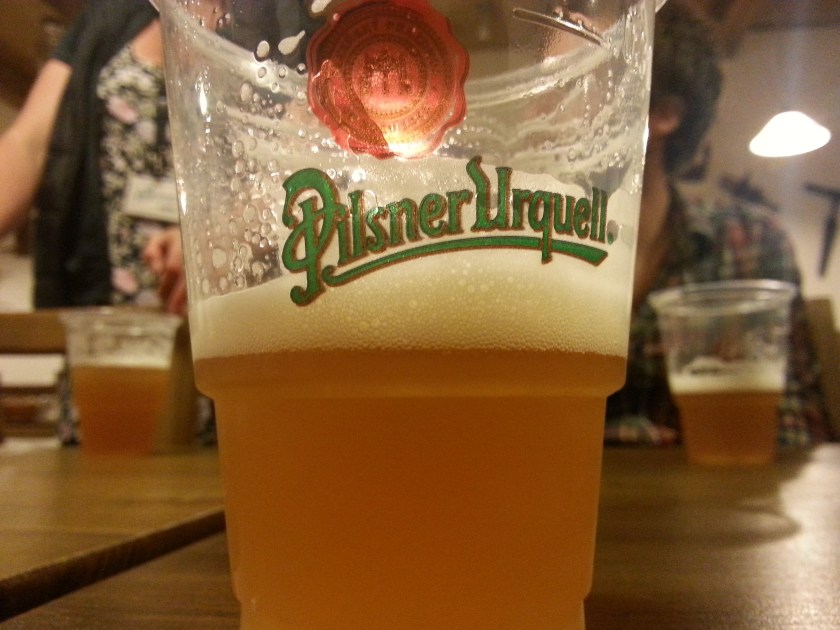
2014-09-04 16.34.19

Back in September, I was invited to visit the Pilsner Urquell brewery by Mark Dredge. Whilst there I had a number of Beer Moments, and one of the biggest was had at the brewery itself in Plzeň, Česká republika (from here on: Pilsen, Czech Republic).


The cellars below the Pilsner Urquell brewery seem to go on forever. Some are collapsed, some chained off, others perfectly intact. One cavernous room once held tonnes of ice, the meltwater flowing through the cellars and the air recirculating to maintain the ideal lagering temperature. These cellars, covering the same area as the town-sized brewery complex itself above ground, would have been just as busy if not busier than the brewery above. A hundred years ago, the thunder of rolling oaken vats would have been the soundtrack to the work of 7000 coopers making 5000 wooden barrels a day below the earth.

Back in 2014, it feels like walking through the bones of some dead leviathan. There are five miles of these tunnels, twenty metres below the ground at their deepest. It’s so easy to think of breweries as a living thing – their veins and arteries pumping lifeblood from one metal organ to the next, procreating in its own unique way – but down here in the cellars, there’s something more crypt-like and supernatural in the atmosphere. Not a sense of death, but of life after death, returning ever stronger, keeping some spirit of what it means to be Pilsner alive in the soul of every oaken timber of every 40 hectolitre barrel. We are warned about the Devil In The Cellars – a ghoulish rock formation down here that’s currently chained off for undisclosed safety reasons.

Our group is led through the darkness by Robert Lobovsky, a native of Pilsen who, after spending his formative years abroad, returned to his homeland and petitioned Pilsner Urquell to give him a job. His job now (Beer Master) is to tell the beer’s story around the world, the story of a beer that to him was part of his Czech identity when he was growing up in Australia. To be Czech means to be from a nation of brewing, and the creation of Pilsner is the Czech’s gift to the world.

On a hill at the highest point of the brewery site, and the city itself, stands a 100 metre high water tower, containing two vast metal tanks that once held the brewery’s water. Below that tower, the ground is seeped with ancient blood. As the highest point in the city, it was the favoured spot for public executions in bygone ages. The brewery’s water is still drawn from the same 100 metre deep well nearby. We joke that the blood and bones of traitors gives the beer its distinct taste but it was that simple, soft water, drawn from 100 metres below ground to sit 100 metres above it, which became the body of one of the world’s most important beers.

Pilsner’s beginning is an unusually precise one in comparison to many other beer styles. I’m so used to bookending historical accounts of beer’s origins with ‘Sources indicate…’ and ‘…or so it is believed’ that Pilsner Urquell’s story seems starkly rigid and underlined in fact by comparison. For one, we have an official origin story for our opening scene: the burghers (property owning citizens) of Pilsen pouring away 36 barrels of beer in the town square in protest against the poor quality brews being made, and forming a co-operative venture that built the brewery used by Joseph Groll to brew the first pale lager beer. We even have an exact date when the first batch was ready and tasted: 11 November 1842. It all seems so black and white – and I have read criticism of this origin story – but as stories go it remains compelling.

Back in the cellars, it’s with barely concealed excitement that I pour myself a glass of unpasteurised, unfiltered Pilsner from the 40 hectolitre wooden vat. These things weigh a few tonnes even when they’re empty,  and every gram of that weight and every year of this beer’s history is weighing down on my mind and on my fingers as I turn that tap handle. It pours like frothy milk at first, eventually churning into a hazy, golden syrup-coloured liquid bright with life. I hold the glass to the dim lights in the cellar, peering into its thick, cloudy, burnished gold colour, topped with an ice-cream scoop of foam the texture of whipped egg whites. I’m expecting something special. Of course I am. Its silky, luscious palate disarms me, that dab of butterscotch so important to its character becomes caramel, then lemon tart, but there’s also a gripping, oily, herbal bitterness that lifts the entire palate up to meet it. It’s raw and alive. It’s perfect.

So much is said about the authenticity of the beer, how closely it compares to its original iterations, with the same culture of yeast, triple decoction, wooden vat maturation and so on. Up until the moment I tasted the beer, it was all I could think about: I wanted to be sent back in time with a sip, to understand and truly comprehend a moment of flavour from a bygone age.

When I tasted it, all those daydreams were shattered, blown to pieces by the sheer excellence of the beer in the glass. We returned later for more, and all I could think about that second time was not how amazing that beer must have seemed the first time it was made, but just how amazing it tastes right now. That’s why a portion of Pilsner Urquell is still matured this way, to taste-match the conventional batches matured in metal, so that they know it still tastes the same.

Like the cellars, this beer’s legacy seems to go on forever. It was the first pale lager beer, so it had little competition at the time, but in the lager-soaked present, it remains head and shoulders above so many lesser Světlý Ležáks (other Czech pale lagers) it shares a country with and the hundreds of foreign imitators. It remains The Pilsner. It’s buried deep.


Of course, there’s a great deal more to Czech beer culture than just one beer, and I’ll try to cover more of it in a couple of future posts. Thanks to Mark Dredge and Pilsner Urquell for their hospitality.

The Emperor’s New Zwanze

IMG_20140920_201603

A belated post about Zwanze Day 2014, hosted in London this year by The Kernel Brewery on 20 September.

I’m not entirely comfortable with pronouncing the word ‘Zwanze’ – one way sounds too much like Swansea or ‘onesie’ (and I think Zwanze Onesies would be the definitive indicator that we’ve reached ‘peak craft’), and the other way of saying it just sounds like a word for futuristic swans. However you say it, it’s the name given to the day celebrated annually when a unique beer brewed by Cantillon is released and enjoyed at various locations around the world, with all kegs being tapped at 9pm Belgian time, wherever it is in the world it’s being tapped.

This year was the first time I’d attended a Zwanze event. I’d been to limited-release-beer launches before though, so I expected a heaving crush of people swarming around a tiny bar, each with a camera-flashing phone in one hand and a artisanal teku glass sloshing enamel-stripping megabeer in the other. I was especially concerned given how busy The Kernel Brewery bar can be on Saturdays (for the Bermondsey Beer Mile) that it could be chaos.

The reality was a very civilised affair, far more calm than a Saturday day session. This a limited list, after all, of people who had registered by email for a glass of this singular beer. It was a simple and effective system: register by email and receive a flyer on arrival entitling you to a glass of Zwanze, so no worries about it running out whilst you’re queuing.

The story of this year’s Zwanze can be found here. It’s a lovely story, and the beer itself has a very considered yet playful construction that really embodies the mind of its creator. Briefly, it’s a three-year-aged, blended, dry-hopped gueuze, blended with kriek and dry hopped again with Bramling X. Reducing it to a sentence does the beer a injustice though, because the canvas it paints across your palate is so much more than its constituent parts.

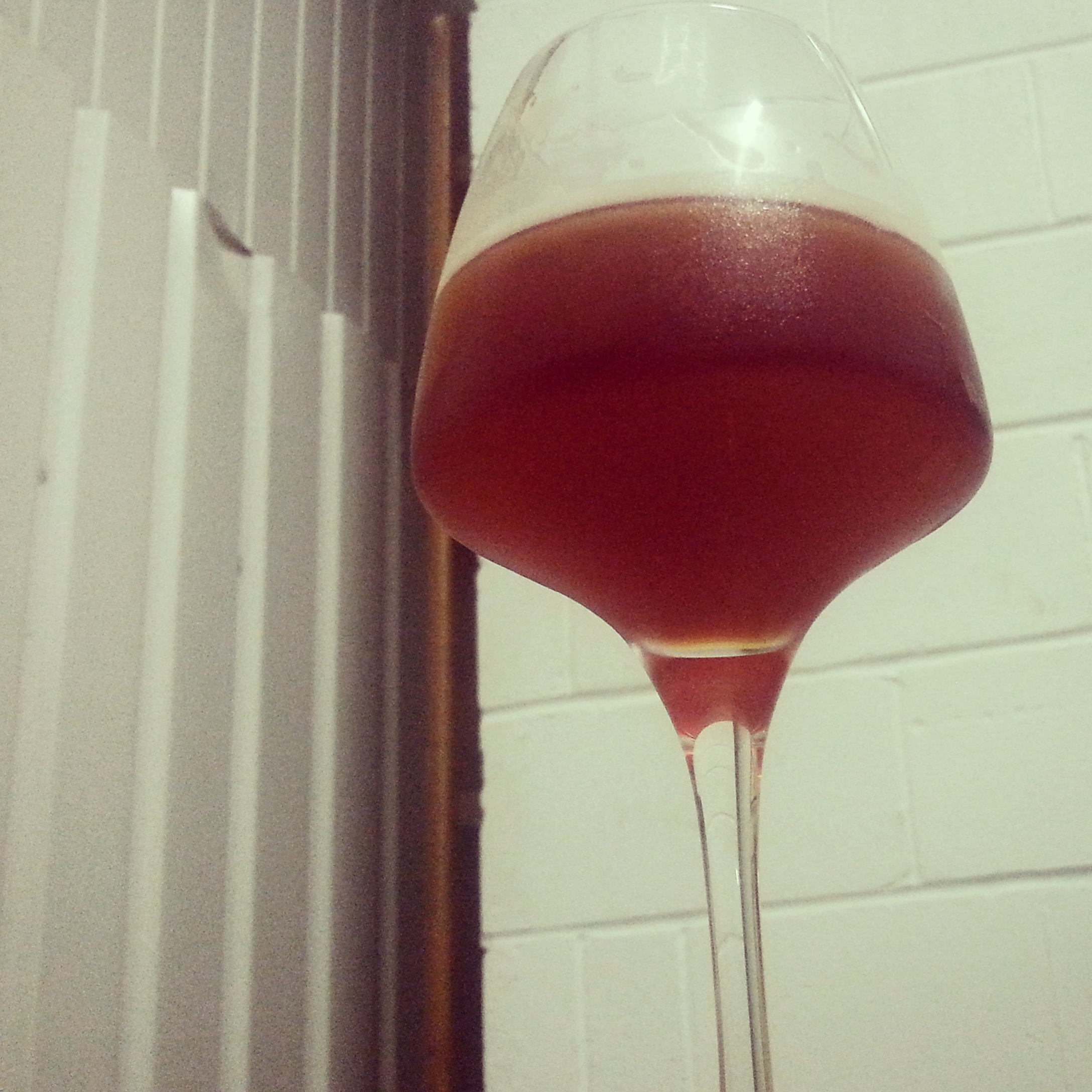
The colour alone, a mahogany-rich maroon with carmine edges, thrills the eyes. The sharp aroma of citrus pith, pepper, linseed oiled cricket bats, leather and overripe blackberries is, at first, baffling. You need a taste to complete the puzzle it presents. The first sip is an artillery barrage of harsh, flat, funk, wrapped in juicy, tart luscious raspberries and white grapes, thicken by the thick cut shred of orange peel in marmalade that gets stuck in your teeth. The finish, more of a crescendo really, is a machine-gun bitterness that sprays around the palate and dries everything it touches with lemon pith, apple skin and wood. Oh, and it is sour – sour like the sky is blue – but it was the dryness that really stuck with me, remarkable and utterly brow-furrowing in its assertiveness.

Of course, with every event like this, there is plenty of commentary online, both positive and negative. Almost universally positive from the people there, and a smattering of negativity from those that aren’t. It’s just the usual stuff, from honest jealousy to more bitter sentiments about the Emperor’s New Clothes, and whether the people attending can fairly judge a beer they’ve registered to try and pay a premium for.

I handed over a paltry £3.50 to taste a third of a pint of that incredible beer, from an exquisite glass in great company in one of the greatest breweries in the world. Considering the beer’s story, the process that made it and the experience I had while drinking it, I fail to see how I got anything less than the best value glass of beer in the world for that money.

Still, it’s a common debate in craft beer that goes way beyond Zwanze, which is normally universally loved every year, and it’s a debate that I struggle with. I can’t logically argue with the notion of people enjoying a beer more because they think they should, or because they’ve paid more for it. Equally, it can easily be argued that such limited release or rare beers can genuinely be astonishingly good. I actually laughed aloud with how good Zwanze was. It tripped across my palate, somersaulted into my brain and hit the necessary synapses to release a laugh of delight from my lips (Fou’Foune prompted a similar reaction, but more from my incredulity at just how sherbety and juicy it is).

I grow concerned that with the maturity of our craft beer scene there is also a steady increase in cynicism, not just the healthy kind that keeps you financially solvent, but the kind that closes one’s mind. The beer itself was a stone cold masterpiece. There can be no doubt about that whatsoever.

Whilst it used to worry me that I too was getting all caught up in the moment and not judging these rare and limited release beers as critically as I should, lately I find myself asking a different question: what if the Emperor’s New Clothes are actually, you know, incredible? What if the reason these people can’t see the Emperor’s New Clothes is because they weren’t there to see them?

Of course, there’s another side to this – criticism of tickers. For me it comes back to The Seeking, something that, more and more, I’m convinced is a very different mindset to that of ticking. I don’t have a problem with ticking – for the most part it’s merely the search of new beers and what they taste like – but it definitely has a dark side to it: those that turn up, tick, leave; or simply wish to be the Mayor of their favourite beer. All harmless enough of course, but for some tickers, it is the tick that motivates them, not the experience that comes with it.

As I grow as a beer drinker and as a writer, it is that concept to which I try to hold fast, no matter what: seek the experience, not the tick. That way, if the experience is this good, then the Emperor’s new clothes look just fine to me.