Green, Hoppy Shoots

A portion of one wall of Sheffield's Hop Hideout.
A portion of one wall of Sheffield’s Hop Hideout.

Sheffield’s Hop Hideout is probably the smallest beer shop I’ve been in. It’s also one of the loveliest, set in one corner of the ground floor of a building full of independent retailers (the Antiques Quarter). It’s a bit like walking through the house from kids TV favourite Finders Keepers, except if the unseen owners of the house were all into vintage clothes and art prints and beer, and every cupboard didn’t explode its contents into a child’s face. Each room full of quirky goods bleeds into the next, reminding me of another TV show from my youth – The Crystal Maze. I think it’s that word ‘Hideout’ that I really like – it suggests something special, a secret treasure for friends to share.

Hop Hideout is a cracking little shop, packing hundreds of beers from around the world into a space smaller than most people’s box rooms. Whether it’s Belgian or German classics you’re after, or the very latest cans from London or California, owners Jules and Will have it covered. They invited Craig Heap and I to do a beer talk/tasting thing (our first ever) just over a week ago, taking place at the Electric Candlelight Cafe in the room next to the shop. We had a great time doing our talk (a tasting through the history of IPA in six beers, with cheese paired to each), and the event attracted a diverse crowd in terms of people and beer knowledge. There were a few regulars among the attendees, and a friendly, informal vibe that suggested a sense of community that really stuck with me.

The pub next door, The Broadfield, had a great range of keg and cask beers on, and a separate dining area propping up its gastropub image. The pub reopened in its current guise just a couple of years before Hop Hideout did, and the pair have formed the nucleus of a small-but-growing craft beer ‘hub’ in the Abbeydale Road area. The area itself is cheap and cheerful for the most part, reminding me of places in Wakefield and Leeds where I lived whilst I was at university and afterwards. But around Hop Hideout, the green, hoppy shoots of a healthy beer scene seem to already be sprouting.

Nearby, an old cinema’s basement is the location for a new bar, Picture House Social, which has asked Hop Hideout to curate a small, rotating beer list for them.  Staff and customers from ‘The Broady’ pub are regularly found perusing the shelves at Hop Hideout on their breaks or after a drinking session at the pub. It all speaks of a communal closeness, something I really enjoy seeing in modern beer culture. The shop is that special treasure, tucked away, reverently enjoyed by those that know where to find it. Many of the nation’s best-loved beer shops started out in much the same way, so I’ve got high hopes for Hop Hideout.

I’ll be keeping a close eye on the the progress of this little Sheffield craft beer microcosm, and I look forward to seeing how it’s grown the next time I visit.

If you find yourself in Sheffield, the 218 bus from the Howard Hotel bus stop opposite the train station will get you to Hop Hideout in about 15 minutes. Oh, and the pies in The Broady come highly recommended.
Leeds International Beer Festival

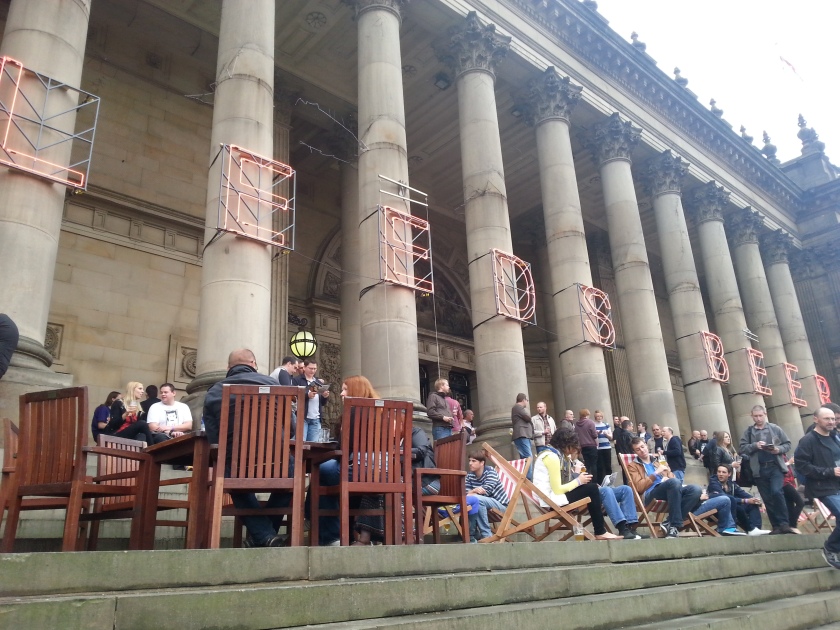
The dramatic entrance to Leeds International Beer Festival, at the Town Hall, Leeds.

My appreciation of good beer began in West Yorkshire.

I went to university in Leeds, and lived in the area for several years afterwards. I arrived there as an alcohol-omnivorous student, drinking Guinness to appear sophisticated, but left with a firm idea of what beer, and good beer, really was. I thought it was something that could be made either locally or far away, but it had to taste proper, and that it had to have something special about it. While I now know the definition of good beer I had as a younger man was vague and nebulous, I occasionally envy his simple understanding. Still, every time I return to Leeds, I’m reminded of great pubs, great beers and great times.

Last weekend, Craig Heap and I returned to Leeds to meet up with friends. It was only a week or so beforehand that I realised Leeds International Beer Festival (LIBF) was on that weekend (honestly). I’d heard good things about the previous two years, and I was curious to see how the Town Hall handled such an event.

It was a fantastic festival. Saturday’s afternoon session was lumbered with damp, drizzly weather, but the outdoor portion (where the street food vendors and disco/beer tent were found) had a music festival atmosphere, while the parts inside the Town Hall reminded me of the better aspects of Craft Beer Rising and London Craft Beer Festival. Friendly staff from the brewers (for the most part) were behind their respective bars, pouring cask and keg beer in great condition from across the UK, US and Europe (Italy and Spain in particular).

It was great to see Ilkley rubbing shoulders with BrewDog, Kernel with newcomers Golden Owl, Magic Rock with Fourpure, Beavertown with Hand Drawn Monkey.  HDM’s Brew #100 was my beer of the festival: a blend of imported Nelson Sauvignon grape must blended with 7% abv DIPA, dry hopped with Nelson Sauvin, refermented and barrel aged in a Sauvignon Blanc barrel. The resulting 11% brew had the electric, crisp and juicy intensity of its two key components in equal amounts, the body of a Greek god but the lightness of touch of a butterfly – a truly stunning technical accomplishment.

London was well represented too, but by no means disproportionately so. It was fantastic to see brewers like Weird Beard bringing some very, very special beers (Ardbeg and Macallan barrel aged versions of Bearded Nurse) and welcoming newcomers to their classics, too. Well, the welcome I got from Gregg Irwin was “You wankers get everywhere!” but I think that was a good thing. Camden Town Brewery brought their classics too, as well as some very tasty rarities, particularly their White Knight (a “barrel-aged Belgian sour”) which was reminiscent of both a tart Berliner weisse and BrewDog’s muscular and woody Everyday Anarchy but at an all-day abv of 4.3%.

It wasn’t all whacky beers, either. There was a healthy representation of handpulls on many bars, with brewers like Marble, Oakham and Kirkstall showing how well-brewed and satisfying cask beers are really done. It was this diversity of intent and execution that really marked LIBF out for me as one of the UK’s best beer festivals. The crowd was happy, friendly and varied: older real-alers wandering over from Mr Foley’s and the Town Hall Tavern to mix with earnest beer geeks seeking the Edge, and lively, facepainted, ‘try-anything’ craft fanciers tasting a lot of beers and styles for the first time. It was that last portion of the demographic that interested me most, and indicates our best hope for all of us continuing to enjoy the great beers like those at LIBF for a long time into the future. Beer festivals need to welcome not just beer geeks, but also people open to the idea of being converted.

Now more than ever, it feels like it was long time ago that CAMRA were providing the best beer festivals in the UK. A very long time ago indeed. Newer, better beer festivals are fighting the good fight in new and better ways, and LIBF is absolutely one of them.

Tapped Out

Tapped Out
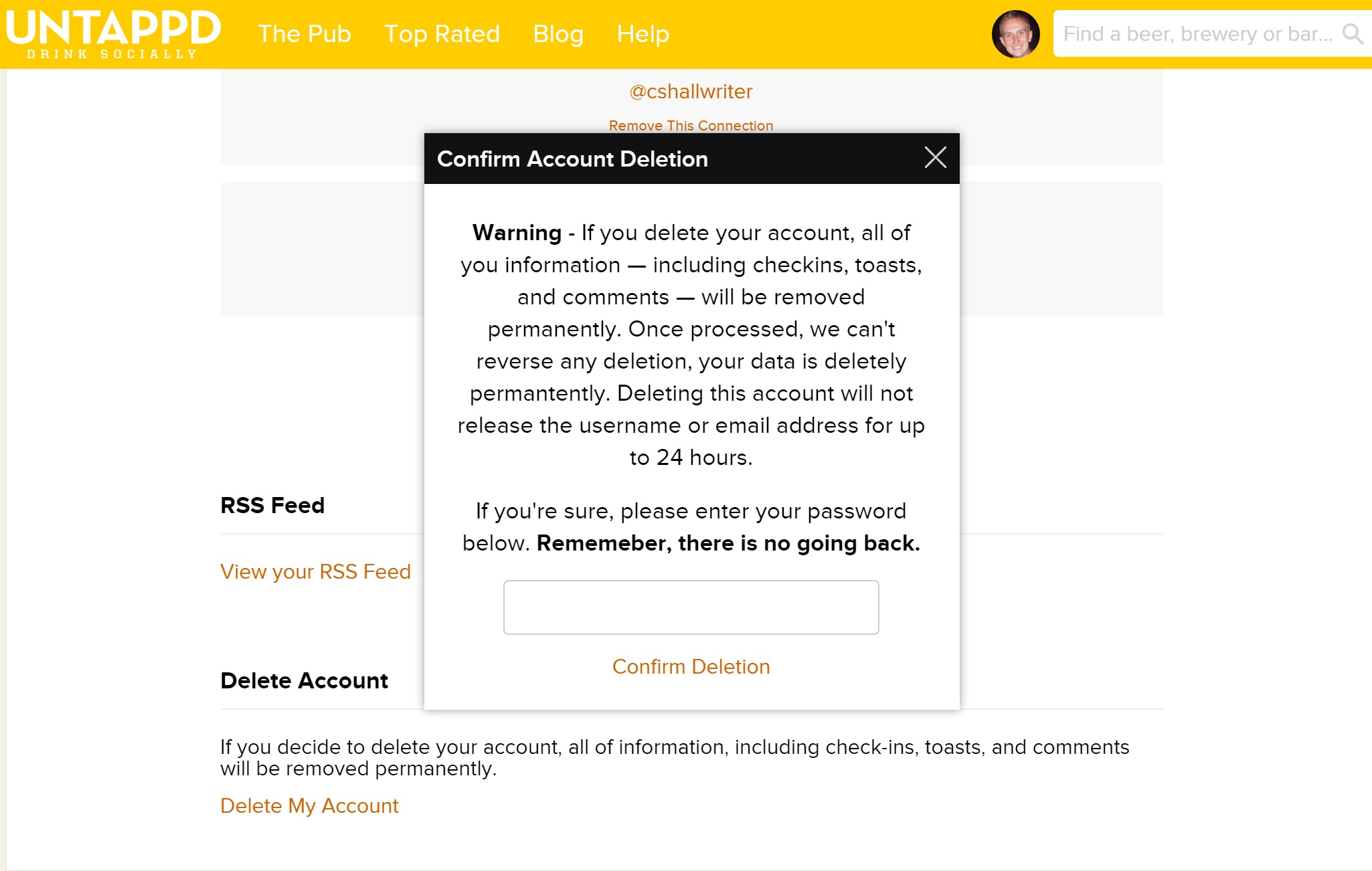
(Wow, count the mistakes in that pop up)


This is a blog post about Untappd. If Untappd makes you angry at them young’uns in the pub with their phones and their Pac-Man video games, this blog post may only serve to raise your blood pressure, so you may want to leave.

Since London Beer City started, I haven’t really logged that many beers onto Untappd, and I’ve had a lot of new beers in the past few weeks. Normally the ‘newness’ is the key motivation for me to check something, not necessarily in a ticking instinct, but so that I have some record of when I first tried it, how strong it was or which batch it was for future reference.

Lately, I just don’t have the energy for Untappd. I got into it only a couple of years ago, having seen others use it and enjoy it. The badges, the social network aspect, the toasts, it all seemed fun, and simply anyone who was anyone was using it, so I gave it a go. Like many forms of social media, it’s addictive. Not just because it merges so neatly with one of my main pastimes, but also because it’s so easy. It becomes a ritual. We see each other all reaching for our phones as we return to a table with our new beers. I don’t have any beef with people using Untappd in pubs, nor do I have any problem with social media becoming part of the way that we enjoy and discuss beer. Still, I simply don’t enjoy using Untappd anymore.

There’s no such thing as ‘casual’ Untappd use, or rather, there’s no point to dabbling in it. You either check in every new beer you have, or why bother using it? The idea is to contribute to a global social network of beer lovers sharing and commenting on each other’s beers. I like the social aspect of it, but Twitter already fulfills that function.

Just over a week ago, I saw this tweet from all-round nice guy and lovely beer person, David Bishop:

Now, despite appearances, David is a shrewd chap and has a healthy attitude to beer geekery. That and his other tweets on the subject very much mirrored my own feelings. It provided the necessary prompt in my mind to really think about it again. What do I get from Untappd? I tweet about beer without its help, can share photos of beers I’m enjoying without its help, keep notes about beers I’ve had without its help.

The useful functions: the searchable archive of beers I’ve had for the first time and when; and the ability to see where beers are being enjoyed near me (which has helped me when visiting a new area a couple of times), are just that – useful, but not essential to my experience of beer. If anything, it causes me more annoyance than satisfaction on average. The Android app is clunky, and frequently crashes when uploading photos, despite several updates.

I’m not sure what I want a beer app to be, or even if I want a replacement for Untappd. I’m certain that, once I delete it from my phone, I’ll experience some cravings. I’ll get my fix other ways, through Instagram, making little felt badges to stick on my Craft Sash at home, Twitter, and so on.

I’m also hoping that, as a side effect, instead of logging every new beer with a few choice flavour descriptors, quitting Untappd will encourage me to actually write about the beers worth writing about.

Is Untappd still doing it for you, or is it something that was fun for a few summers and now needs to go in the loft?